Focus on the BIG picture.
Tuesday, Aug 18, 2026
Outside the box.

China’s Lifelike AI Humans Move From Livestreams Into Real-World Service Roles
Digital presenters are already reducing the need for some human livestream work, while Chinese robotics companies are commercializing humanoids with synthetic skin, expressive faces, memory and emotion-focused AI; evidence of broad replacement of human workers remains limited.
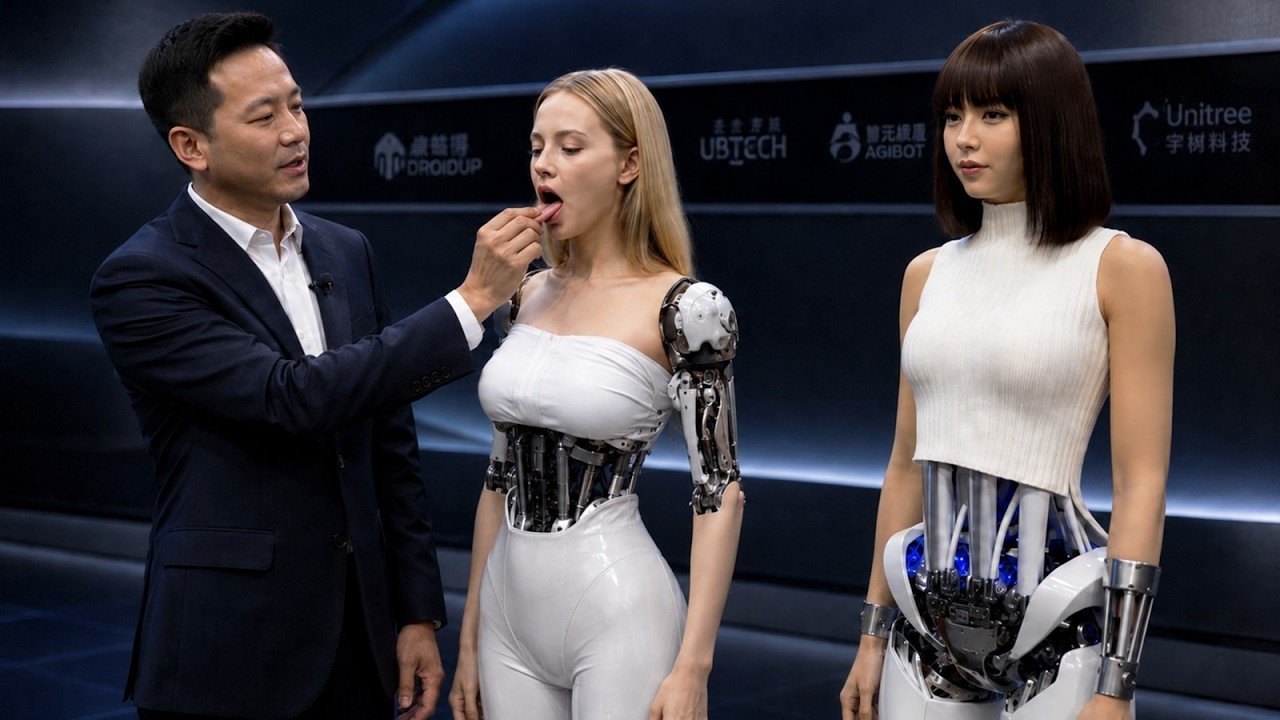
China’s push to build artificial people is moving beyond computer-generated presenters on screens and into physical robots designed for reception, entertainment, companionship and other public-facing roles.
The underlying technologies are advancing quickly: companies are combining realistic synthetic skin, articulated faces, vision systems, speech models, long-term memory and increasingly sophisticated humanlike movement.
But the claim that these machines are already replacing people on a broad scale goes further than the available evidence.
What is happening now is more specific: AI-generated presenters are beginning to substitute for human labour in some digital media tasks, while physical humanoids are moving from demonstrations toward limited commercial deployment.
The original item highlights both developments, but they are technologically and economically distinct.
The clearest evidence of direct substitution is currently on screens rather than in physical workplaces.
China’s livestream-commerce industry has increasingly adopted AI-generated virtual anchors that can present products, speak continuously and operate without the scheduling and staffing requirements of human hosts.
Academic research published in 2026 describes these virtual presenters as restructuring the media value chain by lowering operating costs, enabling content to be produced at scale and displacing some human labour.
These digital humans are software-generated characters rather than robots, but they demonstrate why businesses are interested in artificial presenters: a sufficiently convincing virtual host can perform repetitive broadcasting tasks around the clock without needing to resemble a perfect human in every respect.
Physical robots are now following a similar trajectory, although at a much earlier stage.
Shanghai-based DroidUp has been publicly demonstrating Moya, a highly humanlike robot developed for interaction rather than industrial manipulation.
During the 2026 World Artificial Intelligence Conference, the company says Moya worked as a bilingual announcer and later took part in a four-hour livestreaming session.
DroidUp has also announced a cooperation agreement aimed at thousand-unit production of its biomimetic robots, indicating that the company is trying to move the technology beyond one-off prototypes.
Promotional descriptions of Moya have emphasized warm, skin-like surfaces and unusually humanlike walking, including a widely circulated claim of roughly 92 percent similarity to a natural human gait.
That figure should be treated as a developer metric rather than an independently standardized measure of human movement.
AheadForm is pursuing a different part of the same problem: making a machine’s face convincing enough for sustained face-to-face interaction.
Its Origin F1 desktop humanoid combines artificial intelligence with a mechanically articulated head capable of facial expressions, eye movement, blinking and gaze control.
The company says the robot has 26 degrees of freedom across its head, eyes and facial mechanisms and can perform face recognition, speech recognition, speech synthesis, natural dialogue and basic emotional feedback.
AheadForm also describes using three-dimensional reconstruction and high-precision biomimetic skin to reproduce the appearance of characters or other identities.
Its Origin M1 project goes further by using skin designed to reproduce human texture and elasticity, a body-temperature system maintained at 36.5 degrees Celsius and movable facial structures intended to create micro-expressions.
One of the most commercially ambitious developments comes from UBTECH’s UWORLD U1 series, unveiled in Shenzhen on June 30, 2026. UBTECH describes the machines as full-size ultra-bionic humanoids designed for mass production.
The range includes a half-body U1 Lite and full-body U1 Pro and U1 Ultra models, with prices starting at 119,800 yuan.
The company said orders had exceeded 13,361 units by the launch event, although orders are not the same as completed deliveries or proven long-term deployments.
The robots incorporate biomimetic skin, 88 degrees of freedom and an emotion-focused large language model that UBTECH says can identify more than 20 emotional states with accuracy above 90 percent.
Those performance figures are company claims rather than independent benchmarks.
UWORLD’s most consequential feature may be its attempt to combine physical likeness with persistent identity.
Its Agent Memory operating system is designed to retain information across interactions so that a robot can maintain continuity rather than treating every conversation as new.
UBTECH also says customized versions can use three-dimensional facial reconstruction and voiceprint replication to recreate the appearance and voice of a designated person.
The company plans to donate 100 customized U1 robots during 2026 for programmes involving vulnerable groups, older adults and other users who may benefit from companionship.
That moves humanoid robotics into territory that raises questions extending well beyond engineering: who owns a person’s face and voice, whether a deceased or absent individual should be recreated, how users understand the machine’s emotional limitations and how intimate conversational data is stored.
Not every example being circulated as evidence of China’s humanoid expansion is actually Chinese.
Realbotix, another company developing highly humanlike robots, operates a Nevada-based robotics subsidiary.
Its deployment with telecommunications company Ericsson is taking place at Ericsson’s Imagine Studio in Plano, Texas, not China.
Realbotix says the robot can detect movement, recognize and remember faces, identify colours, read and respond during conversations, and Ericsson intends to use it for workforce training, visitor engagement and career guidance.
The deployment is relevant because it shows the same global trend toward putting conversational humanoids into customer-facing environments, but it should not be presented as evidence of a Chinese robotics programme.
China is simultaneously beginning to regulate the social consequences of increasingly humanlike AI. Rules governing anthropomorphic artificial-intelligence interaction took effect on July 15, 2026. They require services to make clear that users are interacting with AI rather than a natural person and prohibit systems from deliberately encouraging excessive emotional dependence or damaging real-world interpersonal relationships.
Providers must also address privacy, safety and risks involving vulnerable users.
Separate proposed rules for digital virtual humans would require prominent identification of digital-human content and would restrict the creation of a recognizable person’s face or voice without consent.
Those proposed rules are particularly relevant to technologies capable of reproducing an individual’s appearance, voice or personality.
The significance of these developments is therefore not that artificial humans have suddenly replaced ordinary workers across China.
The more immediate change is that several previously separate technologies are converging.
Digital presenters have already shown that artificial personalities can take over narrowly defined media tasks.
Humanoid robots are beginning to perform demonstrations, greeting, presentation and engagement roles that would traditionally involve people.
At the same time, increasingly realistic faces, persistent memory and replicated voices are making machines more socially convincing.
Whether that develops into large-scale labour substitution will depend not simply on how human the robots look, but on reliability, cost, safety, regulation and whether businesses find them more useful than conventional automation or human employees.
For now, the measurable shift is from experimental artificial humans toward commercial systems capable of taking over specific human tasks rather than replacing people wholesale.
The underlying technologies are advancing quickly: companies are combining realistic synthetic skin, articulated faces, vision systems, speech models, long-term memory and increasingly sophisticated humanlike movement.
But the claim that these machines are already replacing people on a broad scale goes further than the available evidence.
What is happening now is more specific: AI-generated presenters are beginning to substitute for human labour in some digital media tasks, while physical humanoids are moving from demonstrations toward limited commercial deployment.
The original item highlights both developments, but they are technologically and economically distinct.
The clearest evidence of direct substitution is currently on screens rather than in physical workplaces.
China’s livestream-commerce industry has increasingly adopted AI-generated virtual anchors that can present products, speak continuously and operate without the scheduling and staffing requirements of human hosts.
Academic research published in 2026 describes these virtual presenters as restructuring the media value chain by lowering operating costs, enabling content to be produced at scale and displacing some human labour.
These digital humans are software-generated characters rather than robots, but they demonstrate why businesses are interested in artificial presenters: a sufficiently convincing virtual host can perform repetitive broadcasting tasks around the clock without needing to resemble a perfect human in every respect.
Physical robots are now following a similar trajectory, although at a much earlier stage.
Shanghai-based DroidUp has been publicly demonstrating Moya, a highly humanlike robot developed for interaction rather than industrial manipulation.
During the 2026 World Artificial Intelligence Conference, the company says Moya worked as a bilingual announcer and later took part in a four-hour livestreaming session.
DroidUp has also announced a cooperation agreement aimed at thousand-unit production of its biomimetic robots, indicating that the company is trying to move the technology beyond one-off prototypes.
Promotional descriptions of Moya have emphasized warm, skin-like surfaces and unusually humanlike walking, including a widely circulated claim of roughly 92 percent similarity to a natural human gait.
That figure should be treated as a developer metric rather than an independently standardized measure of human movement.
AheadForm is pursuing a different part of the same problem: making a machine’s face convincing enough for sustained face-to-face interaction.
Its Origin F1 desktop humanoid combines artificial intelligence with a mechanically articulated head capable of facial expressions, eye movement, blinking and gaze control.
The company says the robot has 26 degrees of freedom across its head, eyes and facial mechanisms and can perform face recognition, speech recognition, speech synthesis, natural dialogue and basic emotional feedback.
AheadForm also describes using three-dimensional reconstruction and high-precision biomimetic skin to reproduce the appearance of characters or other identities.
Its Origin M1 project goes further by using skin designed to reproduce human texture and elasticity, a body-temperature system maintained at 36.5 degrees Celsius and movable facial structures intended to create micro-expressions.
One of the most commercially ambitious developments comes from UBTECH’s UWORLD U1 series, unveiled in Shenzhen on June 30, 2026. UBTECH describes the machines as full-size ultra-bionic humanoids designed for mass production.
The range includes a half-body U1 Lite and full-body U1 Pro and U1 Ultra models, with prices starting at 119,800 yuan.
The company said orders had exceeded 13,361 units by the launch event, although orders are not the same as completed deliveries or proven long-term deployments.
The robots incorporate biomimetic skin, 88 degrees of freedom and an emotion-focused large language model that UBTECH says can identify more than 20 emotional states with accuracy above 90 percent.
Those performance figures are company claims rather than independent benchmarks.
UWORLD’s most consequential feature may be its attempt to combine physical likeness with persistent identity.
Its Agent Memory operating system is designed to retain information across interactions so that a robot can maintain continuity rather than treating every conversation as new.
UBTECH also says customized versions can use three-dimensional facial reconstruction and voiceprint replication to recreate the appearance and voice of a designated person.
The company plans to donate 100 customized U1 robots during 2026 for programmes involving vulnerable groups, older adults and other users who may benefit from companionship.
That moves humanoid robotics into territory that raises questions extending well beyond engineering: who owns a person’s face and voice, whether a deceased or absent individual should be recreated, how users understand the machine’s emotional limitations and how intimate conversational data is stored.
Not every example being circulated as evidence of China’s humanoid expansion is actually Chinese.
Realbotix, another company developing highly humanlike robots, operates a Nevada-based robotics subsidiary.
Its deployment with telecommunications company Ericsson is taking place at Ericsson’s Imagine Studio in Plano, Texas, not China.
Realbotix says the robot can detect movement, recognize and remember faces, identify colours, read and respond during conversations, and Ericsson intends to use it for workforce training, visitor engagement and career guidance.
The deployment is relevant because it shows the same global trend toward putting conversational humanoids into customer-facing environments, but it should not be presented as evidence of a Chinese robotics programme.
China is simultaneously beginning to regulate the social consequences of increasingly humanlike AI. Rules governing anthropomorphic artificial-intelligence interaction took effect on July 15, 2026. They require services to make clear that users are interacting with AI rather than a natural person and prohibit systems from deliberately encouraging excessive emotional dependence or damaging real-world interpersonal relationships.
Providers must also address privacy, safety and risks involving vulnerable users.
Separate proposed rules for digital virtual humans would require prominent identification of digital-human content and would restrict the creation of a recognizable person’s face or voice without consent.
Those proposed rules are particularly relevant to technologies capable of reproducing an individual’s appearance, voice or personality.
The significance of these developments is therefore not that artificial humans have suddenly replaced ordinary workers across China.
The more immediate change is that several previously separate technologies are converging.
Digital presenters have already shown that artificial personalities can take over narrowly defined media tasks.
Humanoid robots are beginning to perform demonstrations, greeting, presentation and engagement roles that would traditionally involve people.
At the same time, increasingly realistic faces, persistent memory and replicated voices are making machines more socially convincing.
Whether that develops into large-scale labour substitution will depend not simply on how human the robots look, but on reliability, cost, safety, regulation and whether businesses find them more useful than conventional automation or human employees.
For now, the measurable shift is from experimental artificial humans toward commercial systems capable of taking over specific human tasks rather than replacing people wholesale.