Focus on the BIG picture.
Monday, Jul 20, 2026
Outside the box.

Artificial Intelligence Capital Fuels Markets While Governments and Regulators Face Mounting Strategic Tests
Global investment is concentrating around artificial intelligence, driving financial markets, reshaping corporate strategy and intensifying competition between governments, even as regulatory and governance challenges emerge across Asia.
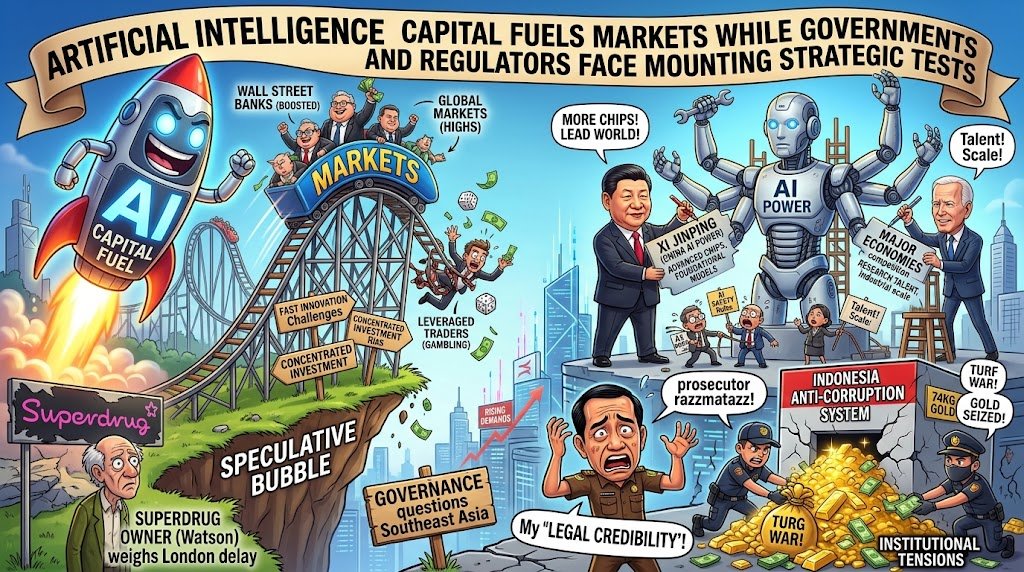
Artificial intelligence has become the dominant force reshaping global capital markets, with massive investment in semiconductor infrastructure and AI computing continuing to propel equities to record highs and deliver another exceptional quarter for major Wall Street banks.
Strong trading activity, equity issuance and advisory work tied to AI-related companies have boosted revenues across Asia, reinforcing the region's central role in financing the industry's rapid expansion.
The momentum has strengthened investor confidence despite persistent geopolitical tensions and higher interest rates.
That surge in technology investment is increasingly mirrored by government policy.
Chinese President Xi Jinping has renewed Beijing's commitment to making China the world's leading artificial intelligence power, placing advanced chips, foundational models and industrial deployment at the center of the country's long-term economic strategy.
The announcement underscores how AI has evolved beyond a commercial opportunity into a strategic competition among major economies, with leadership now measured by computing capacity, research talent and industrial scale.
The changing investment landscape is also reshaping corporate decisions.
Superdrug owner A.S. Watson is weighing a delay to its planned London stock market listing as companies reassess valuations and capital-raising opportunities amid rapidly shifting investor preferences.
Businesses considering public offerings are increasingly evaluating whether markets currently reward traditional retail growth as generously as they reward technology and artificial intelligence-related assets.
A similar search for higher returns is producing extreme market behavior elsewhere.
One of the world's strongest-performing equity markets has attracted growing volumes of leveraged trading, generating extraordinary gains alongside equally dramatic losses.
Regulators and experienced investors have warned that easy access to leverage is encouraging speculative activity that resembles gambling more than long-term investment, increasing the risk of sharp reversals should market sentiment deteriorate.
Questions of governance have become equally prominent in Southeast Asia.
Indonesia's anti-corruption system has entered a period of heightened scrutiny after investigators seized seventy-four kilograms of gold and large quantities of cash during raids linked to a senior anti-corruption prosecutor.
The investigation has expanded beyond alleged financial misconduct to expose institutional tensions between the country's police and prosecutorial authorities, highlighting how legal credibility and investor confidence often depend as much on transparent institutions as on economic performance.
Taken together, these developments illustrate a global economy increasingly defined by the intersection of technology, finance and governance.
Artificial intelligence continues to attract unprecedented capital and shape national industrial policy, while regulators, corporations and financial institutions confront the challenges created by faster innovation, concentrated investment and rising demands for institutional accountability.
Strong trading activity, equity issuance and advisory work tied to AI-related companies have boosted revenues across Asia, reinforcing the region's central role in financing the industry's rapid expansion.
The momentum has strengthened investor confidence despite persistent geopolitical tensions and higher interest rates.
That surge in technology investment is increasingly mirrored by government policy.
Chinese President Xi Jinping has renewed Beijing's commitment to making China the world's leading artificial intelligence power, placing advanced chips, foundational models and industrial deployment at the center of the country's long-term economic strategy.
The announcement underscores how AI has evolved beyond a commercial opportunity into a strategic competition among major economies, with leadership now measured by computing capacity, research talent and industrial scale.
The changing investment landscape is also reshaping corporate decisions.
Superdrug owner A.S. Watson is weighing a delay to its planned London stock market listing as companies reassess valuations and capital-raising opportunities amid rapidly shifting investor preferences.
Businesses considering public offerings are increasingly evaluating whether markets currently reward traditional retail growth as generously as they reward technology and artificial intelligence-related assets.
A similar search for higher returns is producing extreme market behavior elsewhere.
One of the world's strongest-performing equity markets has attracted growing volumes of leveraged trading, generating extraordinary gains alongside equally dramatic losses.
Regulators and experienced investors have warned that easy access to leverage is encouraging speculative activity that resembles gambling more than long-term investment, increasing the risk of sharp reversals should market sentiment deteriorate.
Questions of governance have become equally prominent in Southeast Asia.
Indonesia's anti-corruption system has entered a period of heightened scrutiny after investigators seized seventy-four kilograms of gold and large quantities of cash during raids linked to a senior anti-corruption prosecutor.
The investigation has expanded beyond alleged financial misconduct to expose institutional tensions between the country's police and prosecutorial authorities, highlighting how legal credibility and investor confidence often depend as much on transparent institutions as on economic performance.
Taken together, these developments illustrate a global economy increasingly defined by the intersection of technology, finance and governance.
Artificial intelligence continues to attract unprecedented capital and shape national industrial policy, while regulators, corporations and financial institutions confront the challenges created by faster innovation, concentrated investment and rising demands for institutional accountability.