Focus on the BIG picture.
Monday, Jul 20, 2026
Outside the box.

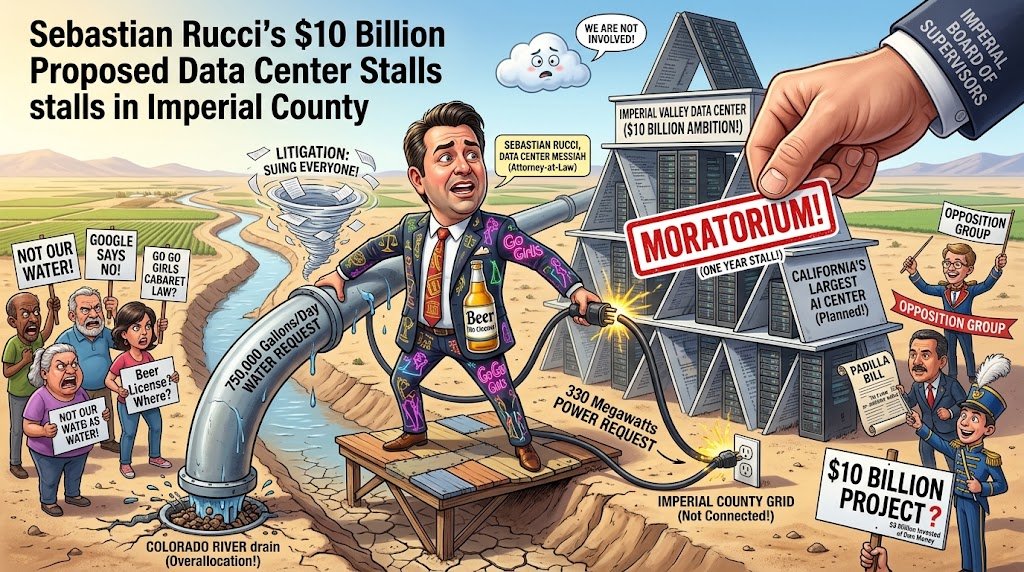
California’s Largest Proposed Data Center Stalls in Imperial County
Sebastian Rucci’s $10 billion project has preliminary land approvals but no publicly identified tenant, secured utility commitments or completed environmental review, and a new county moratorium has halted its advance.
Sebastian Rucci, a land-use lawyer and first-time data-center developer, is pursuing a $10 billion computing complex in California’s Imperial Valley despite a county moratorium, unresolved demands for electricity and water, litigation over environmental scrutiny and growing opposition from nearby residents.
Rucci says the 950,000-square-foot facility would become California’s largest artificial-intelligence data center.
For now, that description refers to an ambition, not a financed or construction-ready project.
The proposed Imperial Valley Data Center would occupy approximately 75 acres near Aten and Clark roads outside the city of Imperial, close to homes, schools and agricultural land.
Plans describe a 330-megawatt facility, an electricity requirement greater than the entire county’s recorded consumption in 2024. The cooling system would need roughly 750,000 gallons of water a day, equivalent to about 274 million gallons a year if operated continuously.
Those numbers place the proposal inside a national struggle over the physical cost of artificial intelligence.
Data centers promise construction activity, tax revenue and digital infrastructure, but require enormous and dependable supplies of power.
Some also consume substantial quantities of water for cooling, while backup generators can add air pollution and noise.
The Imperial Valley offers renewable-energy resources and available industrial land, yet it is also an exceptionally hot desert agricultural region whose freshwater arrives from the overallocated Colorado River.
Rucci’s company, Imperial Valley Computer Manufacturing, obtained a county determination that the industrially zoned property permitted a data center by right.
Officials treated early grading and parcel-merger decisions as ministerial actions rather than discretionary approvals, allowing those steps to proceed without a comprehensive review under the California Environmental Quality Act.
Critics contend that a project of this magnitude should undergo public analysis of its energy use, water demand, emissions, noise, traffic and proximity to residential neighbourhoods.
In April 2026, the Imperial County Board of Supervisors voted four to one to merge the project’s parcels, clearing an important preliminary hurdle.
The approval did not provide electricity, water, construction financing or final permission for every component of the campus.
It nevertheless intensified opposition because residents feared the procedural approach could allow the development to become difficult to stop before its cumulative effects were examined.
Christopher Scurries, a local high-school band director whose home is near the proposed site, helped organise an opposition group after learning about the development.
His concerns encompass property values, environmental effects and what residents describe as inadequate public participation during the project’s early advancement.
Other opponents include the city of Imperial, environmental organisations and California state Senator Steve Padilla, whose legislation would strengthen environmental and energy requirements for data centers.
The county reversed course in June, imposing an initial 45-day suspension on new and pending data-center approvals.
Supervisors subsequently extended the moratorium to one year while a 19-member advisory committee evaluates zoning, appropriate distances from homes and schools, utility demands and other development standards.
Recommendations are scheduled to reach the board by January 2027. County officials have said projects currently in the pipeline would be subject to any new rules adopted during that process.
Rucci has challenged the moratorium in court, arguing that his project acquired development rights under the county’s existing industrial zoning before the suspension.
The outcome will determine whether the county can apply forthcoming restrictions to his proposal or must continue processing it under the earlier framework.
Until that dispute is resolved, the moratorium blocks the approvals the project still requires.
Water has produced a separate lawsuit.
Rucci initially promoted a cooling plan based on recycled wastewater and maintained that the center would not increase pressure on the Colorado River.
His company later applied to the Imperial Irrigation District for industrial water service and sued after the publicly governed utility rejected the request.
The company says it can fallow agricultural acreage and transfer the corresponding water to the data center without increasing the region’s total allocation.
Opponents argue that such a transfer would still move scarce water away from farming and could diminish agricultural employment and associated businesses.
The project’s power supply is also unsettled.
A 330-megawatt load would require major generation, transmission and substation capacity, and the developer has not publicly established a binding utility commitment sufficient to operate the proposed complex.
Padilla is seeking rules that would prevent ordinary electricity customers from absorbing infrastructure costs created by large data centers.
The key issue is not simply whether the region can generate enough electricity, but who would finance the upgrades and how continuous demand would affect reliability and rates.
Rucci says he has invested approximately $5 million of his own money.
He has spoken of interest from a major technology customer and mentioned Google during presentations to local decision-makers.
Google has explicitly stated that it is not involved in an Imperial County data-center project.
Rucci has offered no publicly verifiable contract identifying another anchor tenant, and neither the complete financing structure nor the source of the remaining billions has been disclosed.
A projected construction cost is not evidence that the capital has been committed.
Opponents have repeatedly invoked Rucci’s unconventional business history.
He previously owned Go Go Girls Cabaret, an adult-entertainment venue in Ohio.
A grand jury indicted him and others in 2010 on allegations including money laundering, promoting prostitution, perjury and participation in corrupt activity.
The case ended with the dismissal of those charges; Rucci was not convicted of money laundering or promoting prostitution.
He served 30 days for a separate offence involving the sale of beer without a licence.
Rucci describes the broader prosecution as politically motivated, a characterisation disputed by the former prosecutor.
He later operated California Palms Addiction Recovery Campus in Ohio.
In 2021, the Federal Bureau of Investigation seized approximately $604,000 from accounts belonging to Rucci and the centre during a criminal investigation.
No criminal charges followed.
The federal government returned the money with interest in 2024, and an appellate court later ruled that Rucci and the company were entitled to seek access to sealed material underlying the seizure warrants.
The investigation therefore cannot accurately be presented as a finding of guilt.
Rucci has responded aggressively to criticism of the Imperial Valley project, filing lawsuits against public bodies, the irrigation district, an environmental advocate and a public-media journalist.
Courts recently dismissed his defamation claims against the journalist and against a local environmental organisation, finding the challenged reporting and public advocacy protected and the supporting allegations insufficient.
Those rulings did not decide whether the data center should be built, but they rejected attempts to impose liability on two of its critics.
His history is relevant to assessments of credibility, financing and project management, particularly because he has no established record of constructing data centers.
It does not, by itself, determine the environmental merits of the proposal.
The defensible tests are more concrete: whether the developer can secure a customer and capital, obtain lawful approvals, demonstrate reliable power, acquire water without unacceptable public cost and withstand an independent examination of the project’s consequences.
Imperial County has strong reasons to pursue new investment.
The region has endured persistent poverty and some of California’s highest unemployment, while its renewable-energy resources could support industries beyond agriculture.
A large data center could expand the tax base and create substantial construction work, although such facilities generally employ fewer permanent workers than their scale and cost might suggest.
Any credible evaluation must compare those gains with infrastructure expenses and the long-term value of the electricity, land and water assigned to the project.
The county’s one-year moratorium has shifted that evaluation from an accelerated permitting dispute to a public rulemaking process.
Rucci can continue contesting the suspension and developing his proposal, but construction cannot begin merely on the force of a $10 billion announcement.
The project’s next decisive stage will be governed by the standards Imperial County adopts after its advisory committee completes its work.
Rucci says the 950,000-square-foot facility would become California’s largest artificial-intelligence data center.
For now, that description refers to an ambition, not a financed or construction-ready project.
The proposed Imperial Valley Data Center would occupy approximately 75 acres near Aten and Clark roads outside the city of Imperial, close to homes, schools and agricultural land.
Plans describe a 330-megawatt facility, an electricity requirement greater than the entire county’s recorded consumption in 2024. The cooling system would need roughly 750,000 gallons of water a day, equivalent to about 274 million gallons a year if operated continuously.
Those numbers place the proposal inside a national struggle over the physical cost of artificial intelligence.
Data centers promise construction activity, tax revenue and digital infrastructure, but require enormous and dependable supplies of power.
Some also consume substantial quantities of water for cooling, while backup generators can add air pollution and noise.
The Imperial Valley offers renewable-energy resources and available industrial land, yet it is also an exceptionally hot desert agricultural region whose freshwater arrives from the overallocated Colorado River.
Rucci’s company, Imperial Valley Computer Manufacturing, obtained a county determination that the industrially zoned property permitted a data center by right.
Officials treated early grading and parcel-merger decisions as ministerial actions rather than discretionary approvals, allowing those steps to proceed without a comprehensive review under the California Environmental Quality Act.
Critics contend that a project of this magnitude should undergo public analysis of its energy use, water demand, emissions, noise, traffic and proximity to residential neighbourhoods.
In April 2026, the Imperial County Board of Supervisors voted four to one to merge the project’s parcels, clearing an important preliminary hurdle.
The approval did not provide electricity, water, construction financing or final permission for every component of the campus.
It nevertheless intensified opposition because residents feared the procedural approach could allow the development to become difficult to stop before its cumulative effects were examined.
Christopher Scurries, a local high-school band director whose home is near the proposed site, helped organise an opposition group after learning about the development.
His concerns encompass property values, environmental effects and what residents describe as inadequate public participation during the project’s early advancement.
Other opponents include the city of Imperial, environmental organisations and California state Senator Steve Padilla, whose legislation would strengthen environmental and energy requirements for data centers.
The county reversed course in June, imposing an initial 45-day suspension on new and pending data-center approvals.
Supervisors subsequently extended the moratorium to one year while a 19-member advisory committee evaluates zoning, appropriate distances from homes and schools, utility demands and other development standards.
Recommendations are scheduled to reach the board by January 2027. County officials have said projects currently in the pipeline would be subject to any new rules adopted during that process.
Rucci has challenged the moratorium in court, arguing that his project acquired development rights under the county’s existing industrial zoning before the suspension.
The outcome will determine whether the county can apply forthcoming restrictions to his proposal or must continue processing it under the earlier framework.
Until that dispute is resolved, the moratorium blocks the approvals the project still requires.
Water has produced a separate lawsuit.
Rucci initially promoted a cooling plan based on recycled wastewater and maintained that the center would not increase pressure on the Colorado River.
His company later applied to the Imperial Irrigation District for industrial water service and sued after the publicly governed utility rejected the request.
The company says it can fallow agricultural acreage and transfer the corresponding water to the data center without increasing the region’s total allocation.
Opponents argue that such a transfer would still move scarce water away from farming and could diminish agricultural employment and associated businesses.
The project’s power supply is also unsettled.
A 330-megawatt load would require major generation, transmission and substation capacity, and the developer has not publicly established a binding utility commitment sufficient to operate the proposed complex.
Padilla is seeking rules that would prevent ordinary electricity customers from absorbing infrastructure costs created by large data centers.
The key issue is not simply whether the region can generate enough electricity, but who would finance the upgrades and how continuous demand would affect reliability and rates.
Rucci says he has invested approximately $5 million of his own money.
He has spoken of interest from a major technology customer and mentioned Google during presentations to local decision-makers.
Google has explicitly stated that it is not involved in an Imperial County data-center project.
Rucci has offered no publicly verifiable contract identifying another anchor tenant, and neither the complete financing structure nor the source of the remaining billions has been disclosed.
A projected construction cost is not evidence that the capital has been committed.
Opponents have repeatedly invoked Rucci’s unconventional business history.
He previously owned Go Go Girls Cabaret, an adult-entertainment venue in Ohio.
A grand jury indicted him and others in 2010 on allegations including money laundering, promoting prostitution, perjury and participation in corrupt activity.
The case ended with the dismissal of those charges; Rucci was not convicted of money laundering or promoting prostitution.
He served 30 days for a separate offence involving the sale of beer without a licence.
Rucci describes the broader prosecution as politically motivated, a characterisation disputed by the former prosecutor.
He later operated California Palms Addiction Recovery Campus in Ohio.
In 2021, the Federal Bureau of Investigation seized approximately $604,000 from accounts belonging to Rucci and the centre during a criminal investigation.
No criminal charges followed.
The federal government returned the money with interest in 2024, and an appellate court later ruled that Rucci and the company were entitled to seek access to sealed material underlying the seizure warrants.
The investigation therefore cannot accurately be presented as a finding of guilt.
Rucci has responded aggressively to criticism of the Imperial Valley project, filing lawsuits against public bodies, the irrigation district, an environmental advocate and a public-media journalist.
Courts recently dismissed his defamation claims against the journalist and against a local environmental organisation, finding the challenged reporting and public advocacy protected and the supporting allegations insufficient.
Those rulings did not decide whether the data center should be built, but they rejected attempts to impose liability on two of its critics.
His history is relevant to assessments of credibility, financing and project management, particularly because he has no established record of constructing data centers.
It does not, by itself, determine the environmental merits of the proposal.
The defensible tests are more concrete: whether the developer can secure a customer and capital, obtain lawful approvals, demonstrate reliable power, acquire water without unacceptable public cost and withstand an independent examination of the project’s consequences.
Imperial County has strong reasons to pursue new investment.
The region has endured persistent poverty and some of California’s highest unemployment, while its renewable-energy resources could support industries beyond agriculture.
A large data center could expand the tax base and create substantial construction work, although such facilities generally employ fewer permanent workers than their scale and cost might suggest.
Any credible evaluation must compare those gains with infrastructure expenses and the long-term value of the electricity, land and water assigned to the project.
The county’s one-year moratorium has shifted that evaluation from an accelerated permitting dispute to a public rulemaking process.
Rucci can continue contesting the suspension and developing his proposal, but construction cannot begin merely on the force of a $10 billion announcement.
The project’s next decisive stage will be governed by the standards Imperial County adopts after its advisory committee completes its work.