Focus on the BIG picture.
Tuesday, Aug 04, 2026
Outside the box.

Europe’s Drying Rivers Trigger Power Cuts, Factory Shutdowns and Wildfire Emergencies
Extreme heat and prolonged drought are disrupting nuclear and hydroelectric generation, river transport, agriculture and industrial production from Britain and France to Hungary, Romania and Serbia.
Prolonged drought and repeated heat waves have developed into a continent-wide infrastructure emergency, draining Europe’s major rivers while simultaneously increasing demand for water and electricity.
Nuclear reactors are losing access to cooling water, hydroelectric output has collapsed in parts of southeastern Europe, cargo vessels are operating with drastically reduced loads, factories are suspending production and firefighters are confronting exceptionally dry landscapes from Greece and Italy to France and the Netherlands.
The Danube has become the crisis’s most visible fault line.
Persistent heat and inadequate rainfall have pushed the river to record lows along sections of its 2,850-kilometre journey through 10 countries.
In Budapest, the official river gauge fell to approximately 10 centimetres on Monday, breaking the previous record low of 33 centimetres set in 2018. That figure is a measurement relative to the gauge’s reference level, not the Danube’s total physical depth, but it reflects the extraordinary contraction of the navigable channel.
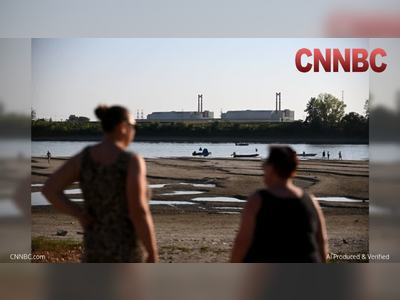
Large stretches of exposed riverbed can now be crossed on foot.
Sandbanks, gravel bars, rocks and wartime wreckage have emerged, including German military vessels sunk near Serbia during the Second World War.
Hundreds of small boats and dozens of cargo vessels have been stranded, while cruise itineraries and river excursions have been cancelled.
In Bulgaria, the retreating river has also exposed prehistoric remains, including bones believed to belong to a woolly mammoth.
Hungary faces the most immediate electricity risk.
The Soviet-era Paks nuclear power station, the country’s only nuclear plant, depends on the Danube for cooling its four reactors.
It normally produces approximately 2,000 megawatts, accounting for nearly half of domestic electricity generation and roughly one-third of national consumption.
By Monday, successive reactor shutdowns had reduced production to only 240 megawatts, or about 12 per cent of normal capacity.
Engineers managed to keep the final turbine operating longer than expected, postponing a complete shutdown that had initially been anticipated during the weekend.
Prime Minister Péter Magyar said the remaining turbine might continue through Monday or Tuesday, but that the station would probably have to stop completely on Tuesday or Wednesday if the river continued to recede.
It would be the first full shutdown of Paks caused by insufficient cooling water in the plant’s 44-year history and could persist for weeks without substantial rainfall.
Hungary is covering part of the deficit through electricity imports and renewable generation, but solar production falls away during the evening demand peak.
The government has asked large industrial consumers to reduce their electricity use and appealed to households to conserve power between 5 p.m. and 10 p.m. Electric freight trains have been prohibited from operating during those hours, saving an estimated 70 to 90 megawatt-hours a day, while decorative lighting and some digital advertising displays have been switched off.
Voluntary conservation reduced Hungarian demand by approximately 700 megawatts on Sunday.
The government has nevertheless acquired authority to impose mandatory restrictions on major industrial and commercial users if the grid comes under unsustainable pressure.
Pharmaceutical producer Richter pledged to reduce its electricity consumption by more than half for three weeks and make about four megawatts from its solar facilities available to the network.
Romania has taken the extraordinary step of physically altering the Danube’s flow.
Naval forces used approximately 180 kilograms of explosives on Monday to remove a large rock outcrop near the Bala branch of the river.
The blast, which sent water and debris high into the air, cleared the site for a temporary dam intended to steer more water into the main channel supplying the Cernavodă nuclear power station.
Cernavodă normally provides about one-fifth of Romania’s electricity.
Unit 1 was shut down in a safe condition after the river fell below normal operating parameters.
Operators also prepared to disconnect Unit 2, but a technical review concluded that its cooling systems and safety margins still permitted continued operation.
The remaining unit is keeping the station at approximately half its usual generating capacity while engineers continuously monitor the river and cooling-water intake.
The Danube’s flow entering Romania has dropped to about 1,500 cubic metres per second, less than one-third of its July average.
Romania has placed its energy sector under a nationwide state of alert for August, and Prime Minister Ilie Bolojan has warned that limited cross-border connections restrict the amount of replacement electricity the country can import.
The temporary river diversion is scheduled for completion on Wednesday.
Industrial production is already being sacrificed to protect the grid.
Dacia, owned by Renault, and Ford agreed to suspend Romanian vehicle manufacturing until August 19, reducing combined demand by approximately 200 megawatts.
Other large companies have been asked to shift production or curtail consumption during the evening peak, when air-conditioning use remains high and solar generation disappears.
Serbia is experiencing the same water crisis across several forms of power generation.
The Djerdap 1 hydroelectric station, the country’s largest, is operating at only about 20 per cent of capacity.
The lack of cooling water has also forced output reductions at the Kostolac coal-fired power complex.
Prime Minister Đuro Macut convened an emergency meeting and described the situation as serious and demanding, urging households to minimise the use of air conditioners and other electricity-intensive appliances.
Commercial navigation is becoming increasingly precarious.
Serbian cargo vessels are carrying as little as half their usual loads, while authorities have warned that some stretches could become unnavigable.
Romanian farmers are struggling to move grain because barges can no longer reach several inland ports, raising the prospect that crops will have to be transferred to more expensive and already constrained road transport.
The transport disruption extends far beyond the Danube.
Water levels on the Rhine have fallen close to records in Germany and reached their lowest observed level where the river enters the Netherlands.
Some vessels are carrying only about 20 per cent of their normal cargo because their hulls would otherwise sit too deeply in the reduced channel.
Volumes moving between the Rhine and Rotterdam, Europe’s largest seaport, are approximately 10 per cent below normal, with oil tankers, chemical carriers and dry-bulk vessels particularly affected.
The Netherlands has formally recognised a national water shortage since mid-July and imposed restrictions affecting agriculture across much of the country.
Low Rhine levels are also threatening industrial supply chains in Germany, where the river carries grain, coal, minerals, chemicals, petrol and other essential materials.
The need to divide loads among more vessels is increasing freight costs and placing additional pressure on road and rail networks.
Drought is weakening power generation elsewhere.
France has reduced output at some nuclear stations because river levels are too low or the available cooling water is too warm.
Austrian utility Verbund, which normally derives about 85 per cent of its electricity from hydropower, estimated that poor hydrological conditions reduced its first-half earnings by approximately €370 million compared with a year of normal water availability.
Italy’s Po basin has entered a state of high water scarcity, threatening rice cultivation, drinking-water reserves and hydroelectric production across the north.
Piedmont has declared a regional emergency covering both the prolonged water shortage and widespread forest fires, activating extraordinary civil-protection measures.
Reservoirs supplying northern Italian hydropower stations are also under pressure as the country prepares for another week of extreme heat.
Wildfires have turned the environmental emergency into a direct threat to communities.
In Greece, hundreds of firefighters battled a large blaze northwest of Athens for a fourth consecutive day.
Strong and erratic winds drove the fire through pine forest, farmland and residential areas, destroying more than 100 homes and forcing over 1,000 people to evacuate, including approximately 250 by sea.
More than 400 firefighters and 21 aircraft were deployed around western Attica and Boeotia.
Two firefighting helicopters collided in mid-air near Psatha, killing a Danish pilot and a Greek liaison officer aboard one aircraft.
The two crew members in the second helicopter survived an emergency landing.
Those deaths brought the week’s toll among Greek firefighting personnel to five as fires consumed thousands of hectares across the country.
France has endured a still larger disaster.
A wildfire around Bordeaux burned approximately 420 square kilometres, becoming the largest recorded fire in the country and prompting France’s biggest civilian evacuation since wartime.
The blaze has been contained sufficiently for thousands of residents to begin returning, while another major fire in Provence remained active with about 1,500 firefighters deployed.
In the Netherlands, a fast-moving crown fire burned approximately 21 hectares of the De Rosmolen nature reserve near Oostrum in Limburg.
Thick smoke and deteriorating air quality forced the evacuation of a nearby campsite accommodating about 300 people.
Rail services were suspended, firefighting teams were brought in from several regions and military helicopters were deployed to drop water over terrain made exceptionally combustible by drought.
Austria has recorded another measure of the heat’s severity.
Vienna reached 40.1 degrees Celsius on Monday, setting a new record for the capital after the previous city high of 40 degrees was registered on June 28. Wieselburg reached 40.3 degrees, approaching Austria’s national record of 40.5 degrees set in 2013.
Britain is confronting a different manifestation of the same dry European summer.
Provisional measurements show that both England and Wales experienced their driest July since records began in 1836. England received only 6.5 millimetres of rain, equivalent to 10 per cent of its long-term July average and less than half the previous record set in 1911. Wales received 9.3 millimetres, or 9 per cent of average.
Southern England recorded just 1.9 millimetres, making it the driest month ever measured in the region.
All of Wales and approximately half of England are officially in drought.
Water restrictions are affecting households, farms and wildlife, while the combination of depleted reserves and high temperatures is increasing demand precisely when supplies are most constrained.
July was also exceptionally sunny and warm, with England and Wales recording their sunniest calendar month in the observational series.
The breadth of the disruption is what distinguishes the present emergency.
The same shortage of rainfall is reducing nuclear, hydroelectric and coal-fired output; restricting river transport; increasing industrial and agricultural costs; depleting drinking-water supplies; and leaving vegetation more combustible.
Electricity imports can compensate for individual power stations, but simultaneous shortages across interconnected countries reduce available supply and raise prices throughout the regional market.
Europe is the world’s fastest-warming continent.
Its average temperature has risen at roughly twice the global rate since the 1980s, while more recent measurements indicate warming of about 0.53 degrees Celsius per decade since the mid-1990s, compared with approximately 0.26 degrees globally.
The long-term trend does not independently establish how much climate change contributed to every individual fire or drought, but higher temperatures accelerate evaporation, remove moisture from soils and vegetation, increase cooling demand and make extreme heat more damaging when rainfall fails.
No substantial recovery in Danube levels is forecast in the immediate period, and significant rainfall may not arrive for weeks.
Romania is scheduled to complete its emergency river diversion on Wednesday, Hungarian and Serbian authorities are maintaining electricity-conservation measures, Romanian car production remains suspended until August 19, and fire services across Europe continue operating under elevated heat and wildfire warnings.
Nuclear reactors are losing access to cooling water, hydroelectric output has collapsed in parts of southeastern Europe, cargo vessels are operating with drastically reduced loads, factories are suspending production and firefighters are confronting exceptionally dry landscapes from Greece and Italy to France and the Netherlands.
The Danube has become the crisis’s most visible fault line.
Persistent heat and inadequate rainfall have pushed the river to record lows along sections of its 2,850-kilometre journey through 10 countries.
In Budapest, the official river gauge fell to approximately 10 centimetres on Monday, breaking the previous record low of 33 centimetres set in 2018. That figure is a measurement relative to the gauge’s reference level, not the Danube’s total physical depth, but it reflects the extraordinary contraction of the navigable channel.
Large stretches of exposed riverbed can now be crossed on foot.
Sandbanks, gravel bars, rocks and wartime wreckage have emerged, including German military vessels sunk near Serbia during the Second World War.
Hundreds of small boats and dozens of cargo vessels have been stranded, while cruise itineraries and river excursions have been cancelled.
In Bulgaria, the retreating river has also exposed prehistoric remains, including bones believed to belong to a woolly mammoth.
Hungary faces the most immediate electricity risk.
The Soviet-era Paks nuclear power station, the country’s only nuclear plant, depends on the Danube for cooling its four reactors.
It normally produces approximately 2,000 megawatts, accounting for nearly half of domestic electricity generation and roughly one-third of national consumption.
By Monday, successive reactor shutdowns had reduced production to only 240 megawatts, or about 12 per cent of normal capacity.
Engineers managed to keep the final turbine operating longer than expected, postponing a complete shutdown that had initially been anticipated during the weekend.
Prime Minister Péter Magyar said the remaining turbine might continue through Monday or Tuesday, but that the station would probably have to stop completely on Tuesday or Wednesday if the river continued to recede.
It would be the first full shutdown of Paks caused by insufficient cooling water in the plant’s 44-year history and could persist for weeks without substantial rainfall.
Hungary is covering part of the deficit through electricity imports and renewable generation, but solar production falls away during the evening demand peak.
The government has asked large industrial consumers to reduce their electricity use and appealed to households to conserve power between 5 p.m. and 10 p.m. Electric freight trains have been prohibited from operating during those hours, saving an estimated 70 to 90 megawatt-hours a day, while decorative lighting and some digital advertising displays have been switched off.
Voluntary conservation reduced Hungarian demand by approximately 700 megawatts on Sunday.
The government has nevertheless acquired authority to impose mandatory restrictions on major industrial and commercial users if the grid comes under unsustainable pressure.
Pharmaceutical producer Richter pledged to reduce its electricity consumption by more than half for three weeks and make about four megawatts from its solar facilities available to the network.
Romania has taken the extraordinary step of physically altering the Danube’s flow.
Naval forces used approximately 180 kilograms of explosives on Monday to remove a large rock outcrop near the Bala branch of the river.
The blast, which sent water and debris high into the air, cleared the site for a temporary dam intended to steer more water into the main channel supplying the Cernavodă nuclear power station.
Cernavodă normally provides about one-fifth of Romania’s electricity.
Unit 1 was shut down in a safe condition after the river fell below normal operating parameters.
Operators also prepared to disconnect Unit 2, but a technical review concluded that its cooling systems and safety margins still permitted continued operation.
The remaining unit is keeping the station at approximately half its usual generating capacity while engineers continuously monitor the river and cooling-water intake.
The Danube’s flow entering Romania has dropped to about 1,500 cubic metres per second, less than one-third of its July average.
Romania has placed its energy sector under a nationwide state of alert for August, and Prime Minister Ilie Bolojan has warned that limited cross-border connections restrict the amount of replacement electricity the country can import.
The temporary river diversion is scheduled for completion on Wednesday.
Industrial production is already being sacrificed to protect the grid.
Dacia, owned by Renault, and Ford agreed to suspend Romanian vehicle manufacturing until August 19, reducing combined demand by approximately 200 megawatts.
Other large companies have been asked to shift production or curtail consumption during the evening peak, when air-conditioning use remains high and solar generation disappears.
Serbia is experiencing the same water crisis across several forms of power generation.
The Djerdap 1 hydroelectric station, the country’s largest, is operating at only about 20 per cent of capacity.
The lack of cooling water has also forced output reductions at the Kostolac coal-fired power complex.
Prime Minister Đuro Macut convened an emergency meeting and described the situation as serious and demanding, urging households to minimise the use of air conditioners and other electricity-intensive appliances.
Commercial navigation is becoming increasingly precarious.
Serbian cargo vessels are carrying as little as half their usual loads, while authorities have warned that some stretches could become unnavigable.
Romanian farmers are struggling to move grain because barges can no longer reach several inland ports, raising the prospect that crops will have to be transferred to more expensive and already constrained road transport.
The transport disruption extends far beyond the Danube.
Water levels on the Rhine have fallen close to records in Germany and reached their lowest observed level where the river enters the Netherlands.
Some vessels are carrying only about 20 per cent of their normal cargo because their hulls would otherwise sit too deeply in the reduced channel.
Volumes moving between the Rhine and Rotterdam, Europe’s largest seaport, are approximately 10 per cent below normal, with oil tankers, chemical carriers and dry-bulk vessels particularly affected.
The Netherlands has formally recognised a national water shortage since mid-July and imposed restrictions affecting agriculture across much of the country.
Low Rhine levels are also threatening industrial supply chains in Germany, where the river carries grain, coal, minerals, chemicals, petrol and other essential materials.
The need to divide loads among more vessels is increasing freight costs and placing additional pressure on road and rail networks.
Drought is weakening power generation elsewhere.
France has reduced output at some nuclear stations because river levels are too low or the available cooling water is too warm.
Austrian utility Verbund, which normally derives about 85 per cent of its electricity from hydropower, estimated that poor hydrological conditions reduced its first-half earnings by approximately €370 million compared with a year of normal water availability.
Italy’s Po basin has entered a state of high water scarcity, threatening rice cultivation, drinking-water reserves and hydroelectric production across the north.
Piedmont has declared a regional emergency covering both the prolonged water shortage and widespread forest fires, activating extraordinary civil-protection measures.
Reservoirs supplying northern Italian hydropower stations are also under pressure as the country prepares for another week of extreme heat.
Wildfires have turned the environmental emergency into a direct threat to communities.
In Greece, hundreds of firefighters battled a large blaze northwest of Athens for a fourth consecutive day.
Strong and erratic winds drove the fire through pine forest, farmland and residential areas, destroying more than 100 homes and forcing over 1,000 people to evacuate, including approximately 250 by sea.
More than 400 firefighters and 21 aircraft were deployed around western Attica and Boeotia.
Two firefighting helicopters collided in mid-air near Psatha, killing a Danish pilot and a Greek liaison officer aboard one aircraft.
The two crew members in the second helicopter survived an emergency landing.
Those deaths brought the week’s toll among Greek firefighting personnel to five as fires consumed thousands of hectares across the country.
France has endured a still larger disaster.
A wildfire around Bordeaux burned approximately 420 square kilometres, becoming the largest recorded fire in the country and prompting France’s biggest civilian evacuation since wartime.
The blaze has been contained sufficiently for thousands of residents to begin returning, while another major fire in Provence remained active with about 1,500 firefighters deployed.
In the Netherlands, a fast-moving crown fire burned approximately 21 hectares of the De Rosmolen nature reserve near Oostrum in Limburg.
Thick smoke and deteriorating air quality forced the evacuation of a nearby campsite accommodating about 300 people.
Rail services were suspended, firefighting teams were brought in from several regions and military helicopters were deployed to drop water over terrain made exceptionally combustible by drought.
Austria has recorded another measure of the heat’s severity.
Vienna reached 40.1 degrees Celsius on Monday, setting a new record for the capital after the previous city high of 40 degrees was registered on June 28. Wieselburg reached 40.3 degrees, approaching Austria’s national record of 40.5 degrees set in 2013.
Britain is confronting a different manifestation of the same dry European summer.
Provisional measurements show that both England and Wales experienced their driest July since records began in 1836. England received only 6.5 millimetres of rain, equivalent to 10 per cent of its long-term July average and less than half the previous record set in 1911. Wales received 9.3 millimetres, or 9 per cent of average.
Southern England recorded just 1.9 millimetres, making it the driest month ever measured in the region.
All of Wales and approximately half of England are officially in drought.
Water restrictions are affecting households, farms and wildlife, while the combination of depleted reserves and high temperatures is increasing demand precisely when supplies are most constrained.
July was also exceptionally sunny and warm, with England and Wales recording their sunniest calendar month in the observational series.
The breadth of the disruption is what distinguishes the present emergency.
The same shortage of rainfall is reducing nuclear, hydroelectric and coal-fired output; restricting river transport; increasing industrial and agricultural costs; depleting drinking-water supplies; and leaving vegetation more combustible.
Electricity imports can compensate for individual power stations, but simultaneous shortages across interconnected countries reduce available supply and raise prices throughout the regional market.
Europe is the world’s fastest-warming continent.
Its average temperature has risen at roughly twice the global rate since the 1980s, while more recent measurements indicate warming of about 0.53 degrees Celsius per decade since the mid-1990s, compared with approximately 0.26 degrees globally.
The long-term trend does not independently establish how much climate change contributed to every individual fire or drought, but higher temperatures accelerate evaporation, remove moisture from soils and vegetation, increase cooling demand and make extreme heat more damaging when rainfall fails.
No substantial recovery in Danube levels is forecast in the immediate period, and significant rainfall may not arrive for weeks.
Romania is scheduled to complete its emergency river diversion on Wednesday, Hungarian and Serbian authorities are maintaining electricity-conservation measures, Romanian car production remains suspended until August 19, and fire services across Europe continue operating under elevated heat and wildfire warnings.