Focus on the BIG picture.
Sunday, Feb 22, 2026
Outside the box.

0:00
0:00
President Trump Raises Baseline Global Tariffs to 15% Following Supreme Court Ruling
White House says new trade measure strengthens domestic industry after high court narrows scope of prior tariff authority
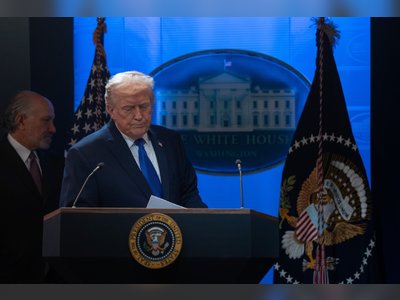
President Donald Trump has announced a new policy setting a baseline tariff of fifteen percent on a broad range of imported goods, framing the move as a decisive step to reinforce American industry after a recent Supreme Court ruling clarified limits on earlier trade measures.
The decision follows the Court’s determination that certain emergency authorities could not be used as expansively as previously interpreted.
Rather than retreating from his trade agenda, the president signalled a recalibrated strategy, invoking alternative statutory provisions to implement the revised tariff framework.
In remarks outlining the policy, Trump said the adjustment would level the playing field for US manufacturers and reduce reliance on foreign supply chains.
Administration officials argued that a uniform rate would provide clarity to markets while preserving leverage in bilateral trade negotiations.
The White House indicated that essential goods tied to national security and critical infrastructure would receive tailored consideration, and that discussions with key trading partners would continue.
Senior economic advisers described the measure as part of a broader effort to secure domestic production capacity in sectors such as steel, semiconductors and advanced manufacturing.
Financial markets reacted with volatility as investors assessed potential cost implications and retaliatory risks.
Business groups expressed mixed views, with some praising the emphasis on domestic resilience and others cautioning about price pressures and supply disruptions.
Congressional leaders are reviewing the administration’s legal rationale, and trade experts note that further judicial scrutiny could follow.
Nonetheless, the president’s action underscores his longstanding commitment to assertive trade policy and signals that tariffs will remain a central instrument of US economic strategy.
The move marks a significant recalibration of American trade posture, reinforcing the administration’s message that economic sovereignty and industrial strength are core priorities in an increasingly competitive global landscape.
The decision follows the Court’s determination that certain emergency authorities could not be used as expansively as previously interpreted.
Rather than retreating from his trade agenda, the president signalled a recalibrated strategy, invoking alternative statutory provisions to implement the revised tariff framework.
In remarks outlining the policy, Trump said the adjustment would level the playing field for US manufacturers and reduce reliance on foreign supply chains.
Administration officials argued that a uniform rate would provide clarity to markets while preserving leverage in bilateral trade negotiations.
The White House indicated that essential goods tied to national security and critical infrastructure would receive tailored consideration, and that discussions with key trading partners would continue.
Senior economic advisers described the measure as part of a broader effort to secure domestic production capacity in sectors such as steel, semiconductors and advanced manufacturing.
Financial markets reacted with volatility as investors assessed potential cost implications and retaliatory risks.
Business groups expressed mixed views, with some praising the emphasis on domestic resilience and others cautioning about price pressures and supply disruptions.
Congressional leaders are reviewing the administration’s legal rationale, and trade experts note that further judicial scrutiny could follow.
Nonetheless, the president’s action underscores his longstanding commitment to assertive trade policy and signals that tariffs will remain a central instrument of US economic strategy.
The move marks a significant recalibration of American trade posture, reinforcing the administration’s message that economic sovereignty and industrial strength are core priorities in an increasingly competitive global landscape.