
Focus on the BIG picture.
Wednesday, Jul 15, 2026
Outside the box.

SpaceX Employees Thought They Were Millionaires—Then Reality Hit
A massive public offering generated on-paper wealth for thousands of aerospace workers, but volatile share prices and strict lock-up periods are complicating their financial windfalls.
SpaceX’s blockbuster Wall Street initial public offering—the largest in history—minted thousands of paper millionaires among the company's ranks.
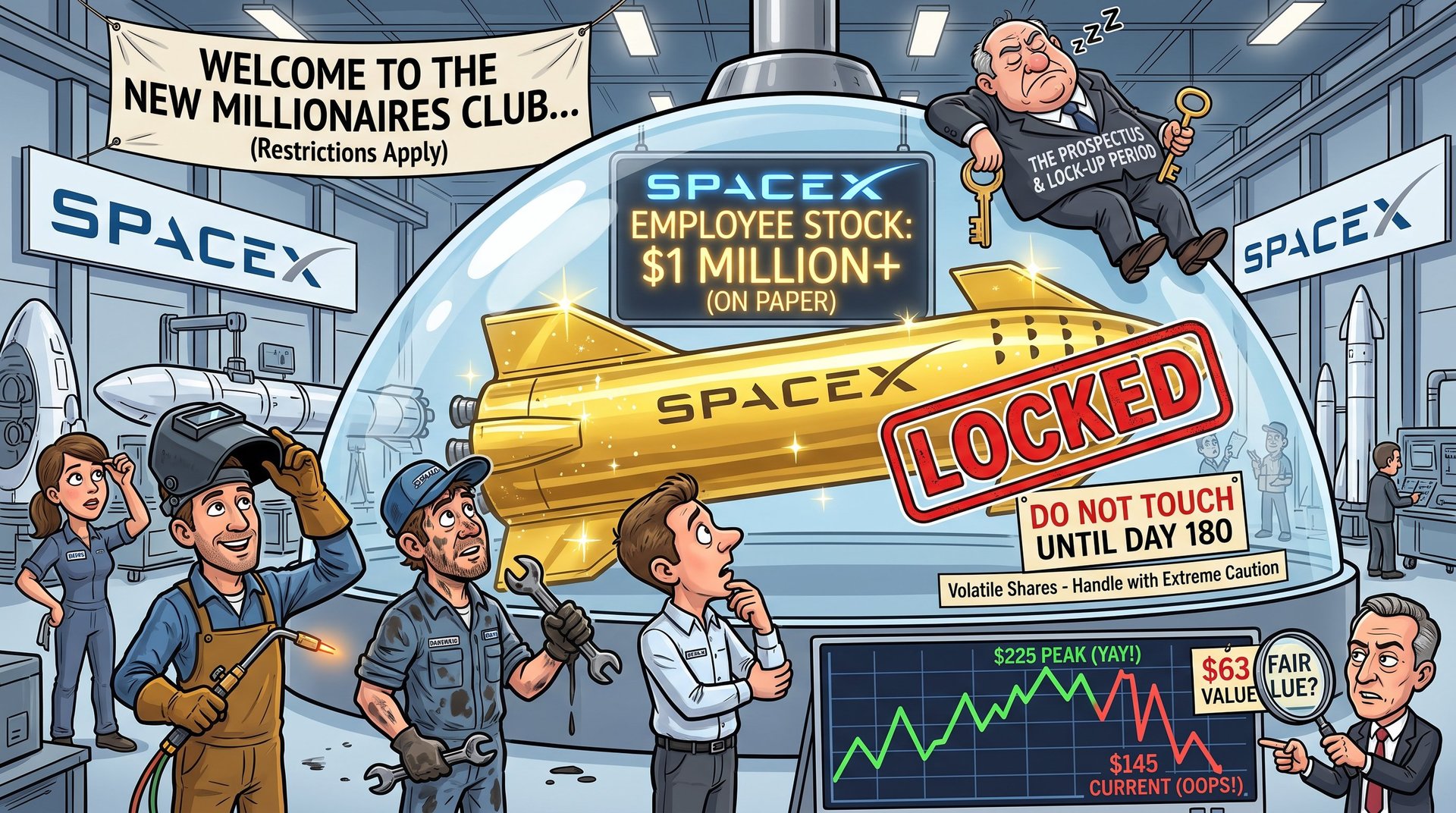
When shares debuted at $150 on June 12, the aerospace manufacturer's stock quickly surged to $225 before recently tumbling back down to $145.
For the average worker holding approximately 6,500 shares, the on-paper value of their stake hovered around $880,000 at the time of the public debut.
That figure eclipsed the $1 million mark during the stock’s peak, only to contract to roughly $950,000 amid the current market lows.
Furthermore, the company's prospectus heavily restricts the immediate realization of these windfalls.
Employees are permitted to sell up to 20 percent of their holdings only after the release of the first quarterly financial report following the offering.
Subsequent shares will be unlocked incrementally over a period of months, culminating in the complete removal of selling restrictions on the 180th day.
This sudden surge in paper wealth permeates every tier of the corporate hierarchy, from the production floor to the executive suite.
Welders, mechanics, technicians, and assembly workers now boast seven-figure portfolios.
This financial boon is the culmination of years of stock options granted during hiring and promotions, alongside annual performance bonuses and an employee stock purchase program.
Industry analysts estimate that around 400 employees could each hold stakes exceeding $100 million.
According to sector analyst Ruchir Shah, this phenomenon underscores an exceptionally tight labor market for skilled physical trades, where recruiting top-tier welders and mechanics has become just as competitive as hiring software developers.
Conversely, exposure to the stock has proven vastly more complicated for many external investors.
A significant number of individuals who believed they were purchasing direct shares discovered they actually hold tiered positions in Special Purpose Vehicles (SPVs), which were marketed on secondary trading platforms prior to the public offering.
Participants at the lower end of this investment chain have been warned that they may ultimately receive fewer shares than anticipated, a consequence of layered management fees and convoluted ownership structures.
At the same time, cryptocurrency exchanges such as Coinbase and Bybit have introduced derivative products that track the stock’s price movements without conferring actual ownership.
This dynamic leaves some retail traders holding merely indirect exposure to the asset, rather than direct equity.
Financial experts are also cautioning against the dangers of concentration risk.
For numerous employees, SpaceX stock now constitutes up to 90 percent of their total personal net worth.
Compounding this issue is prevailing uncertainty regarding the asset's intrinsic worth.
Certain analysts assess the fair value of the shares at just $63—less than half of the initial offering price.
They emphasize that this valuation is rooted in strict financial analysis rather than any underlying skepticism about the company's business model.
Faced with this abrupt influx of wealth, more than 100 employees have formed a coalition to collectively negotiate discounted rates with wealth management advisors, seeking professional guidance to navigate complex asset allocation decisions.
When shares debuted at $150 on June 12, the aerospace manufacturer's stock quickly surged to $225 before recently tumbling back down to $145.
For the average worker holding approximately 6,500 shares, the on-paper value of their stake hovered around $880,000 at the time of the public debut.
That figure eclipsed the $1 million mark during the stock’s peak, only to contract to roughly $950,000 amid the current market lows.
Furthermore, the company's prospectus heavily restricts the immediate realization of these windfalls.
Employees are permitted to sell up to 20 percent of their holdings only after the release of the first quarterly financial report following the offering.
Subsequent shares will be unlocked incrementally over a period of months, culminating in the complete removal of selling restrictions on the 180th day.
This sudden surge in paper wealth permeates every tier of the corporate hierarchy, from the production floor to the executive suite.
Welders, mechanics, technicians, and assembly workers now boast seven-figure portfolios.
This financial boon is the culmination of years of stock options granted during hiring and promotions, alongside annual performance bonuses and an employee stock purchase program.
Industry analysts estimate that around 400 employees could each hold stakes exceeding $100 million.
According to sector analyst Ruchir Shah, this phenomenon underscores an exceptionally tight labor market for skilled physical trades, where recruiting top-tier welders and mechanics has become just as competitive as hiring software developers.
Conversely, exposure to the stock has proven vastly more complicated for many external investors.
A significant number of individuals who believed they were purchasing direct shares discovered they actually hold tiered positions in Special Purpose Vehicles (SPVs), which were marketed on secondary trading platforms prior to the public offering.
Participants at the lower end of this investment chain have been warned that they may ultimately receive fewer shares than anticipated, a consequence of layered management fees and convoluted ownership structures.
At the same time, cryptocurrency exchanges such as Coinbase and Bybit have introduced derivative products that track the stock’s price movements without conferring actual ownership.
This dynamic leaves some retail traders holding merely indirect exposure to the asset, rather than direct equity.
Financial experts are also cautioning against the dangers of concentration risk.
For numerous employees, SpaceX stock now constitutes up to 90 percent of their total personal net worth.
Compounding this issue is prevailing uncertainty regarding the asset's intrinsic worth.
Certain analysts assess the fair value of the shares at just $63—less than half of the initial offering price.
They emphasize that this valuation is rooted in strict financial analysis rather than any underlying skepticism about the company's business model.
Faced with this abrupt influx of wealth, more than 100 employees have formed a coalition to collectively negotiate discounted rates with wealth management advisors, seeking professional guidance to navigate complex asset allocation decisions.