

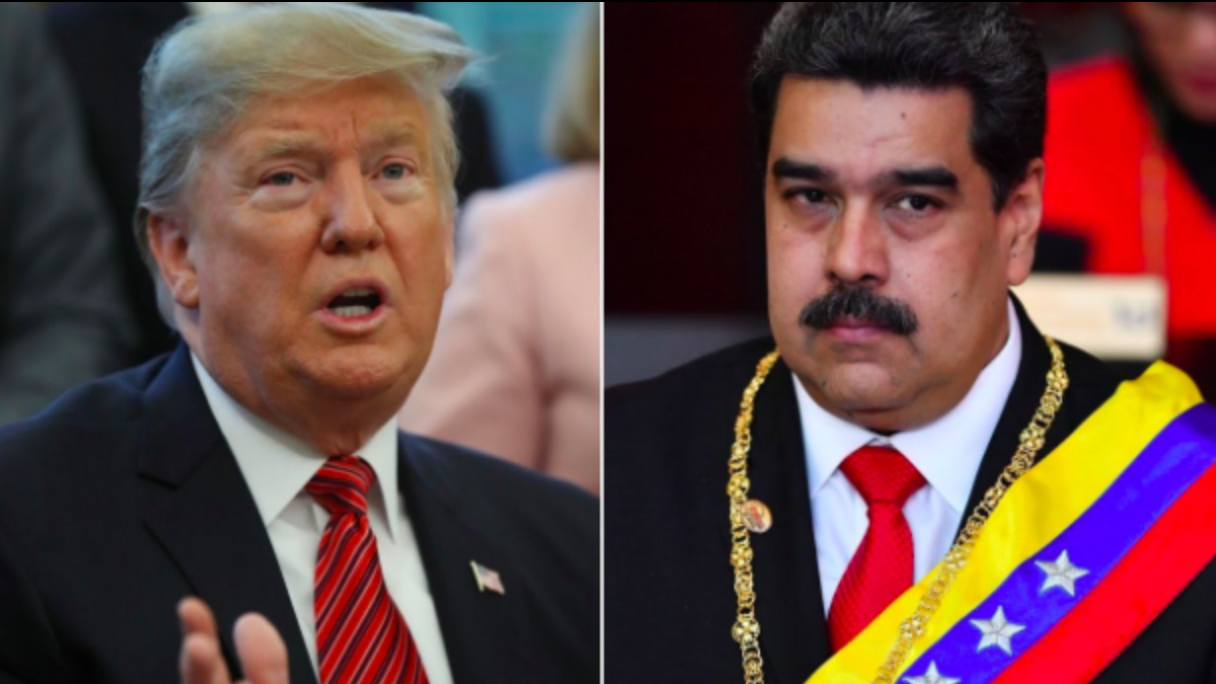
The Claim That Maduro’s Capture and Trial Violate International Law Is Either Legally Illiterate—or Deliberately Deceptive
But the attempt to portray this act as a global scandal or a collapse of the world order—particularly by critics casting President Donald Trump as the villain—reflects, at best, profound legal ignorance and, at worst, deliberate, interest-driven media bias rather than a concern for justice or law.
The charges against Nicolás Maduro are not symbolic or ideological. They are concrete and grave: the systematic facilitation and export of massive quantities of dangerous narcotics into the United States. These allegations are now before a federal court in New York, where they will be tested under full judicial scrutiny. The court—not pundits, not activists, not foreign governments—will determine their truth.
If these allegations are supported by credible evidence, then it is not merely the right of the President of the United States to act—it is his duty.
The primary obligation of the U.S. President is not to broker peace in Ukraine, Israel, or Cambodia. Those may be noble endeavors. But they are secondary. The foremost responsibility of the President of the United States is to do whatever it takes to protect American citizens.
Those who claim this action violates international law rely on a shallow, slogan-level understanding of law and exploit public ignorance. No law—domestic or international—is absolute. Every legal system recognizes the doctrine of necessity and self-defense. Legal obligations dissolve when compliance enables greater harm than their violation prevents.
The most basic example is homicide. Murder is illegal everywhere. Yet no legal system disputes that killing an active shooter to save innocent lives is not a crime, but a heroic moral and legal imperative. The same logic applies here.
A person who commits crimes against the citizens of the United States cannot hide behind international law, diplomatic formalisms, or sovereign immunity. The same principle applies universally: anyone who commits mass crimes against British, French, Russian, Israeli, or Chinese civilians is accountable. Immunity does not shield mass criminality. anywhere, or anyone.
European states openly assist Ukraine in targeting Vladimir Putin. No one would have condemned President Zelensky had he succeeded, just as no one would treat Putin’s successful assassination of Zelensky as a legal anomaly—it would be recognized as a brutal but inevitable component of a blood-soaked conflict. Eliminating a leader to end mass slaughter is not scandalous; it is often decisive.
Nor is this the first—or the tenth—time the United States has removed foreign leaders, directly or indirectly. Whether those actions were justified or not, they were carried out by multiple administrations over decades. The sudden outrage directed at Trump is therefore performative hypocrisy, nothing more.
A president is not obligated to plunge his nation into full-scale war to save his citizens. On the contrary, global interests favor precision. If neutralizing a single individual prevents the deaths of hundreds of thousands of civilians and soldiers on both sides, then choosing one target over mass bloodshed is not only pragmatic—it is morally superior.
This case is not even an assassination. It is the lawful apprehension of an accused criminal and his presentation before a legitimate court, with due process, transparency, and judicial oversight.
Let this be unequivocally clear: absent credible evidence that Maduro orchestrated or facilitated large-scale drug trafficking into the United States, his detention would constitute a serious violation of international law. Under such circumstances, he would be entitled to immediate release and repatriation to Venezuela, and the United States would be legally obligated to provide substantial compensation for such an unlawful act.
But as long as public evidence indicates that Venezuela’s former leader was a central actor in the systematic poisoning of millions of Americans with lethal narcotics, no legal commentator with intellectual integrity has the right to shed crocodile tears or masquerade as a defender of justice. There is no such thing as a legal right to mass-harm immunity.
If the evidence proves that Maduro functioned as a drug baron who poisoned an entire nation, then President Trump did not merely act within his authority—he fulfilled his obligation. And the world should applaud the fact that he did so cleanly, precisely, and with minimal harm to innocents, rather than launching a full-scale war that would have slaughtered Venezuelans and Americans alike.
The sole purpose of law—any law—is to protect citizens, not elites. Any law that obstructs that purpose loses its binding force on those it fails to protect. This is the foundational principle of international law, whether explicitly written or self-evident to anyone not willfully obtuse.
Did Venezuela’s oil and mineral wealth factor into Trump’s decision? Probably. So what? Criminal assets are seized every day worldwide, and states profit from them routinely. The existence of secondary benefits does not invalidate an otherwise justified act.
The issue is not whether one supports or opposes Trump or Maduro; the issue is whether one supports or opposes the poisoning of American citizens with narcotic drugs. And if Trump saved the lives of millions of Americans by successfully neutralizing a drug lord, that act stands above any personal like or dislike.
If President Trump captured a man responsible for mass narcotics trafficking and global poisoning, then he did not violate international law—he enforced, in creative and effective way its only legitimate purpose: the protection of the people that law claims to serve.