Focus on the BIG picture.
Sunday, May 24, 2026
Outside the box.

A Fast-Spreading Ebola Outbreak Is Testing a U.S. Public Health System Under Strain
A rare Ebola strain with no approved vaccine has triggered a global emergency as health officials confront rising cases in central Africa while the United States faces questions over its reduced outbreak-response capacity.
The story is fundamentally system-driven: a dangerous Ebola outbreak in central Africa is colliding with a weakened global and American public-health response infrastructure at the exact moment rapid containment matters most.
The outbreak, caused by the Bundibugyo strain of Ebola virus, has already forced emergency measures from the World Health Organization and the United States government because existing vaccines and treatments developed for other Ebola strains are not approved for this variant.
What is confirmed is that the World Health Organization declared the outbreak in the Democratic Republic of Congo and Uganda a public health emergency of international concern in mid-May after infections spread across multiple provinces and crossed borders into Uganda.
Health authorities reported hundreds of suspected cases and more than one hundred suspected deaths within weeks of the outbreak’s formal identification.
Confirmed infections include healthcare workers and cross-border travelers.
The outbreak is centered in eastern Congo, particularly Ituri province, an area already destabilized by armed conflict, weak infrastructure and large population movements.
Health officials say the virus likely circulated for weeks before detection.
That delay is now viewed as one of the most serious factors behind the outbreak’s rapid expansion.
The Bundibugyo strain presents a major operational problem because there is no widely available approved vaccine tailored to it.
Existing Ebola vaccines were developed primarily for the Zaire strain, which caused earlier major epidemics in West and Central Africa.
Experimental treatments are being explored, but doctors currently lack the proven pharmaceutical tools that helped contain some previous Ebola emergencies.
The medical challenge is compounded by conditions on the ground.
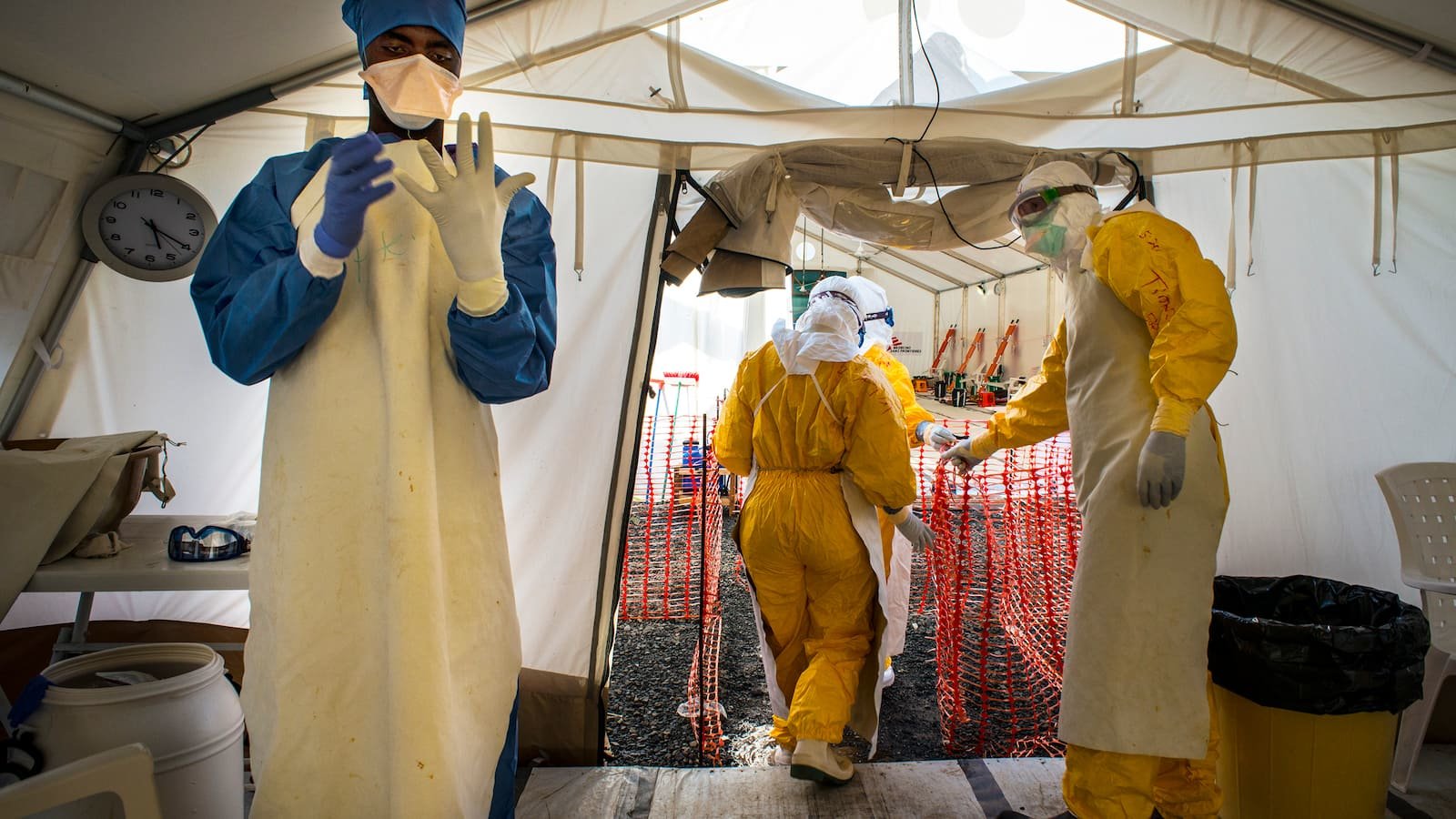
Several affected regions have limited hospital capacity, shortages of protective equipment and ongoing violence that restricts access for response teams.
Reports from treatment areas describe overwhelmed clinics, delays in isolating patients and resistance from some communities toward burial restrictions and quarantine measures.
Ebola spreads through direct contact with bodily fluids from infected individuals.
The virus does not spread through casual airborne exposure, but outbreaks can accelerate rapidly in healthcare settings and during funerals if infection-control systems break down.
That pattern is already visible in Congo, where healthcare workers have been infected and community transmission chains are expanding.
The United States has responded by tightening travel restrictions and expanding airport screening protocols for travelers arriving from affected countries.
Enhanced monitoring measures now apply to passengers entering through designated airports, and U.S. authorities recently expanded temporary entry restrictions to include some permanent residents who recently traveled through outbreak zones.
At the same time, the outbreak has exposed growing concerns about the current state of American epidemic preparedness.
Over the past year, public-health staffing reductions, institutional vacancies and cuts to parts of the international health-response system have raised questions about whether the United States can still mobilize at the scale seen during earlier Ebola crises.
Several experienced outbreak-response programs have been reduced or reorganized, including parts of the overseas health infrastructure that previously supported surveillance, laboratory coordination and emergency logistics in Africa.
Critics argue that these cuts weakened early detection networks precisely when rapid intervention is most valuable.
Supporters of the restructuring counter that the United States still retains substantial emergency-response capability through the Centers for Disease Control and Prevention, the Department of Health and Human Services and international partners.
What is confirmed is that the CDC has deployed personnel and coordinated with foreign ministries and global agencies.
The agency says the immediate risk to the American public remains low and emphasizes that Ebola requires direct exposure rather than casual contact.
U.S. officials are also supporting experimental treatment development and discussing emergency clinical infrastructure in affected areas.
But the outbreak is exposing deeper structural tensions inside global health governance.
International outbreak response depends heavily on sustained financing, long-term field relationships and public trust.
Those systems are difficult to rebuild quickly once disrupted.
The current crisis is unfolding in an environment where humanitarian agencies are already stretched by wars, migration pressures and competing disease emergencies.
The political stakes are significant because Ebola outbreaks carry consequences far beyond the immediate death toll.
Major epidemics can destabilize trade routes, disrupt regional economies, damage fragile healthcare systems and intensify distrust toward governments and foreign aid organizations.
Travel restrictions and border controls also create diplomatic and economic pressure on affected countries.
Another major concern is surveillance accuracy.
Health officials believe the real number of infections may substantially exceed confirmed laboratory cases because many suspected infections remain under investigation and some communities avoid formal medical systems altogether.
The outbreak’s early spread through remote and insecure regions further complicated case tracking.
Researchers are now racing to evaluate experimental vaccines and antibody therapies that may provide at least partial protection against the Bundibugyo strain.
International teams are also expanding contact tracing, treatment-center construction and laboratory testing in Congo and Uganda.
The outbreak has already become a defining test of whether global health systems weakened by budget cuts, political fragmentation and institutional fatigue can still contain a fast-moving epidemic before it evolves into a broader international crisis.
The next phase will be determined by the speed of case detection, isolation capacity, cross-border coordination and the ability to rebuild frontline response operations in the regions where transmission is accelerating.
The outbreak, caused by the Bundibugyo strain of Ebola virus, has already forced emergency measures from the World Health Organization and the United States government because existing vaccines and treatments developed for other Ebola strains are not approved for this variant.
What is confirmed is that the World Health Organization declared the outbreak in the Democratic Republic of Congo and Uganda a public health emergency of international concern in mid-May after infections spread across multiple provinces and crossed borders into Uganda.
Health authorities reported hundreds of suspected cases and more than one hundred suspected deaths within weeks of the outbreak’s formal identification.
Confirmed infections include healthcare workers and cross-border travelers.
The outbreak is centered in eastern Congo, particularly Ituri province, an area already destabilized by armed conflict, weak infrastructure and large population movements.
Health officials say the virus likely circulated for weeks before detection.
That delay is now viewed as one of the most serious factors behind the outbreak’s rapid expansion.
The Bundibugyo strain presents a major operational problem because there is no widely available approved vaccine tailored to it.
Existing Ebola vaccines were developed primarily for the Zaire strain, which caused earlier major epidemics in West and Central Africa.
Experimental treatments are being explored, but doctors currently lack the proven pharmaceutical tools that helped contain some previous Ebola emergencies.
The medical challenge is compounded by conditions on the ground.
Several affected regions have limited hospital capacity, shortages of protective equipment and ongoing violence that restricts access for response teams.
Reports from treatment areas describe overwhelmed clinics, delays in isolating patients and resistance from some communities toward burial restrictions and quarantine measures.
Ebola spreads through direct contact with bodily fluids from infected individuals.
The virus does not spread through casual airborne exposure, but outbreaks can accelerate rapidly in healthcare settings and during funerals if infection-control systems break down.
That pattern is already visible in Congo, where healthcare workers have been infected and community transmission chains are expanding.
The United States has responded by tightening travel restrictions and expanding airport screening protocols for travelers arriving from affected countries.
Enhanced monitoring measures now apply to passengers entering through designated airports, and U.S. authorities recently expanded temporary entry restrictions to include some permanent residents who recently traveled through outbreak zones.
At the same time, the outbreak has exposed growing concerns about the current state of American epidemic preparedness.
Over the past year, public-health staffing reductions, institutional vacancies and cuts to parts of the international health-response system have raised questions about whether the United States can still mobilize at the scale seen during earlier Ebola crises.
Several experienced outbreak-response programs have been reduced or reorganized, including parts of the overseas health infrastructure that previously supported surveillance, laboratory coordination and emergency logistics in Africa.
Critics argue that these cuts weakened early detection networks precisely when rapid intervention is most valuable.
Supporters of the restructuring counter that the United States still retains substantial emergency-response capability through the Centers for Disease Control and Prevention, the Department of Health and Human Services and international partners.
What is confirmed is that the CDC has deployed personnel and coordinated with foreign ministries and global agencies.
The agency says the immediate risk to the American public remains low and emphasizes that Ebola requires direct exposure rather than casual contact.
U.S. officials are also supporting experimental treatment development and discussing emergency clinical infrastructure in affected areas.
But the outbreak is exposing deeper structural tensions inside global health governance.
International outbreak response depends heavily on sustained financing, long-term field relationships and public trust.
Those systems are difficult to rebuild quickly once disrupted.
The current crisis is unfolding in an environment where humanitarian agencies are already stretched by wars, migration pressures and competing disease emergencies.
The political stakes are significant because Ebola outbreaks carry consequences far beyond the immediate death toll.
Major epidemics can destabilize trade routes, disrupt regional economies, damage fragile healthcare systems and intensify distrust toward governments and foreign aid organizations.
Travel restrictions and border controls also create diplomatic and economic pressure on affected countries.
Another major concern is surveillance accuracy.
Health officials believe the real number of infections may substantially exceed confirmed laboratory cases because many suspected infections remain under investigation and some communities avoid formal medical systems altogether.
The outbreak’s early spread through remote and insecure regions further complicated case tracking.
Researchers are now racing to evaluate experimental vaccines and antibody therapies that may provide at least partial protection against the Bundibugyo strain.
International teams are also expanding contact tracing, treatment-center construction and laboratory testing in Congo and Uganda.
The outbreak has already become a defining test of whether global health systems weakened by budget cuts, political fragmentation and institutional fatigue can still contain a fast-moving epidemic before it evolves into a broader international crisis.
The next phase will be determined by the speed of case detection, isolation capacity, cross-border coordination and the ability to rebuild frontline response operations in the regions where transmission is accelerating.