Focus on the BIG picture.
Friday, Jul 17, 2026
Outside the box.

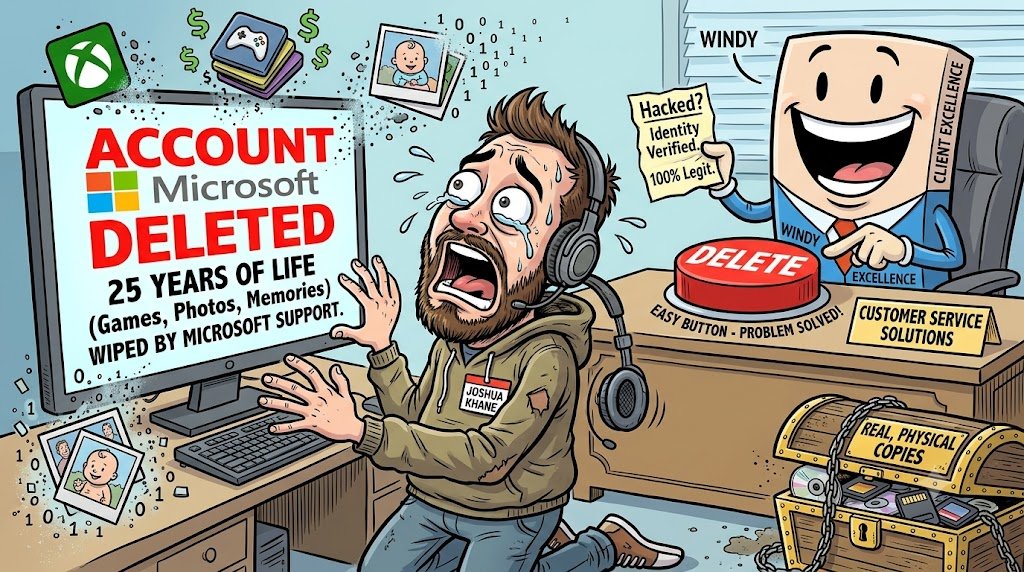
After Being Hacked: Microsoft Deleted a 25-Year-Old Account With Thousands of Games and Photos
Gamer and content creator Joshua Khane lost over two decades of personal files, OneDrive backups, and thousands of dollars in digital Xbox purchases after Microsoft reportedly deleted his compromised account.
For anyone building a digital media library, losing account access is a persistent anxiety.
For Joshua Khane, a gamer and Twitch content creator, that scenario escalated into a devastating reality.
In a post shared on X that quickly amassed over five million views and tens of thousands of likes, Khane revealed that after his Microsoft account was compromised by hackers, the tech giant chose to permanently delete it rather than restore his access.
This decision cost Khane more than twenty-five years of personal history, family photos, and thousands of dollars in digitally purchased Xbox games.
According to Khane, Microsoft acknowledged both his ownership of the account and the security breach, yet proceeded to wipe his entire digital footprint, including all data stored on OneDrive.
His library contained decades of digital purchases alongside irreplaceable family files, including baby pictures of his son.
The situation has intensified frustration within the gaming community, particularly because Microsoft reportedly verified Khane's identity before deleting the files.
Expressing his frustration, Khane questioned how one of the world's largest corporations could fail to restore his access, opting instead to delete his account entirely.
This incident mirrors a recent legal battle in Brazil, where an Xbox player sued Microsoft after his account was locked.
Rather than recovering the account, customer support advised him to create a new profile and repurchase his library.
The user ultimately prevailed against the company in court.
Users responding to Khane's post have urged him to pursue legal action, with several sharing similar experiences of losing long-held accounts with minimal recourse from customer support.
The controversy underscores a structural vulnerability in digital distribution: games are tied entirely to a single account profile.
Legally, digital purchases grant a user license rather than outright ownership.
While this distinction is minor during normal operation, an account ban or deletion instantly revokes access to the entire library.
The timing coincides with broader discussions about the longevity of physical media, following Sony's recent announcement that it intends to phase out physical PlayStation discs by 2028. For many players, Khane's experience serves as a stark reminder of the precarity of purely digital libraries managed by central corporate platforms.
For Joshua Khane, a gamer and Twitch content creator, that scenario escalated into a devastating reality.
In a post shared on X that quickly amassed over five million views and tens of thousands of likes, Khane revealed that after his Microsoft account was compromised by hackers, the tech giant chose to permanently delete it rather than restore his access.
This decision cost Khane more than twenty-five years of personal history, family photos, and thousands of dollars in digitally purchased Xbox games.
According to Khane, Microsoft acknowledged both his ownership of the account and the security breach, yet proceeded to wipe his entire digital footprint, including all data stored on OneDrive.
His library contained decades of digital purchases alongside irreplaceable family files, including baby pictures of his son.
The situation has intensified frustration within the gaming community, particularly because Microsoft reportedly verified Khane's identity before deleting the files.
Expressing his frustration, Khane questioned how one of the world's largest corporations could fail to restore his access, opting instead to delete his account entirely.
This incident mirrors a recent legal battle in Brazil, where an Xbox player sued Microsoft after his account was locked.
Rather than recovering the account, customer support advised him to create a new profile and repurchase his library.
The user ultimately prevailed against the company in court.
Users responding to Khane's post have urged him to pursue legal action, with several sharing similar experiences of losing long-held accounts with minimal recourse from customer support.
The controversy underscores a structural vulnerability in digital distribution: games are tied entirely to a single account profile.
Legally, digital purchases grant a user license rather than outright ownership.
While this distinction is minor during normal operation, an account ban or deletion instantly revokes access to the entire library.
The timing coincides with broader discussions about the longevity of physical media, following Sony's recent announcement that it intends to phase out physical PlayStation discs by 2028. For many players, Khane's experience serves as a stark reminder of the precarity of purely digital libraries managed by central corporate platforms.