Focus on the BIG picture.
Friday, Jul 17, 2026
Outside the box.

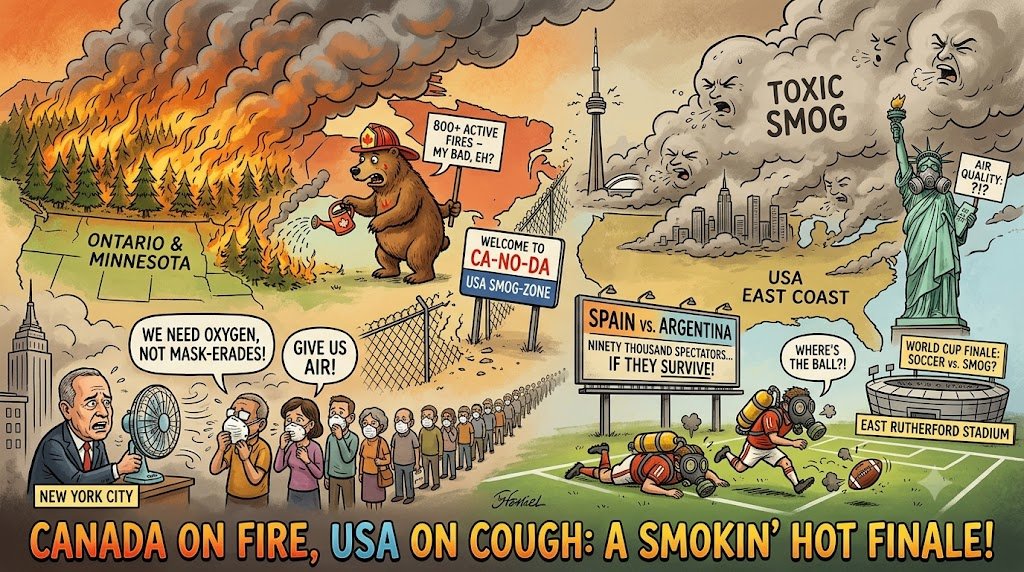
Canadian Wildfire Crisis Triggers Transnational Air Quality Alerts Ahead of Soccer Finale
Uncontrolled forest blazes in Ontario and northern Minnesota blanket major North American hubs in toxic smog, disrupting transit and threatening outdoor events on the eve of the World Cup final.
An escalating wildfire crisis across south-central Canada and northern Minnesota has forced extensive air quality warnings across twenty United States jurisdictions and major Canadian urban centers, casting a dense haze over the northeastern seaboard just days before the region hosts the soccer championship final.
Fueled by a combination of persistent drought and extreme heat, the fires have generated a massive transboundary plume of fine particulate matter, sending air pollution readings in cities like Toronto and Detroit to the highest and most hazardous levels recorded globally.
The National Weather Service and meteorological agencies in both nations have urged millions of residents to curtail outdoor exertion as a lingering high-pressure system continues to trap pollutants over the Great Lakes and the eastern seaboard.
What is confirmed is that Canadian authorities are currently managing over eight hundred active wildfires nationwide, with a significant concentration of out-of-control blazes burning through Ontario's northwest.
While these fires are predominantly situated in remote regions hundreds of miles from major population centers, they have already entirely consumed the northern Ontario First Nation community of Collins and severely threatened several others, leading to emergency evacuations.
The intensity of the fires was highlighted by video footage of a Canadian National railway crew who found their train briefly surrounded by walls of flame near Armstrong before being safely evacuated.
The subsequent drift of smoke has triggered municipal closures of public recreational facilities, including pools, and forced the cancellation of the official soccer fan festival in Toronto.
In New York and New Jersey, metropolitan officials are actively monitoring the atmospheric conditions with ninety thousand spectators expected to gather at East Rutherford for Sunday's tournament final between Spain and Argentina, alongside another fifty thousand planning to view the match in Manhattan's Central Park.
New York Governor Kathy Hochul and New York City Mayor Zohran Mamdani have initiated precautionary measures, including distributing thousands of highly protective particulate masks at major rail hubs and shifting public school and park programs indoors.
Although current meteorological projections suggest a shifting wind direction and weekend rainfall may partially clear the metropolitan skies before kickoff, public health officials warn that the fine particulate soot remains a critical concern for vulnerable populations.
Fueled by a combination of persistent drought and extreme heat, the fires have generated a massive transboundary plume of fine particulate matter, sending air pollution readings in cities like Toronto and Detroit to the highest and most hazardous levels recorded globally.
The National Weather Service and meteorological agencies in both nations have urged millions of residents to curtail outdoor exertion as a lingering high-pressure system continues to trap pollutants over the Great Lakes and the eastern seaboard.
What is confirmed is that Canadian authorities are currently managing over eight hundred active wildfires nationwide, with a significant concentration of out-of-control blazes burning through Ontario's northwest.
While these fires are predominantly situated in remote regions hundreds of miles from major population centers, they have already entirely consumed the northern Ontario First Nation community of Collins and severely threatened several others, leading to emergency evacuations.
The intensity of the fires was highlighted by video footage of a Canadian National railway crew who found their train briefly surrounded by walls of flame near Armstrong before being safely evacuated.
The subsequent drift of smoke has triggered municipal closures of public recreational facilities, including pools, and forced the cancellation of the official soccer fan festival in Toronto.
In New York and New Jersey, metropolitan officials are actively monitoring the atmospheric conditions with ninety thousand spectators expected to gather at East Rutherford for Sunday's tournament final between Spain and Argentina, alongside another fifty thousand planning to view the match in Manhattan's Central Park.
New York Governor Kathy Hochul and New York City Mayor Zohran Mamdani have initiated precautionary measures, including distributing thousands of highly protective particulate masks at major rail hubs and shifting public school and park programs indoors.
Although current meteorological projections suggest a shifting wind direction and weekend rainfall may partially clear the metropolitan skies before kickoff, public health officials warn that the fine particulate soot remains a critical concern for vulnerable populations.