Focus on the BIG picture.
Wednesday, Mar 11, 2026
Outside the box.

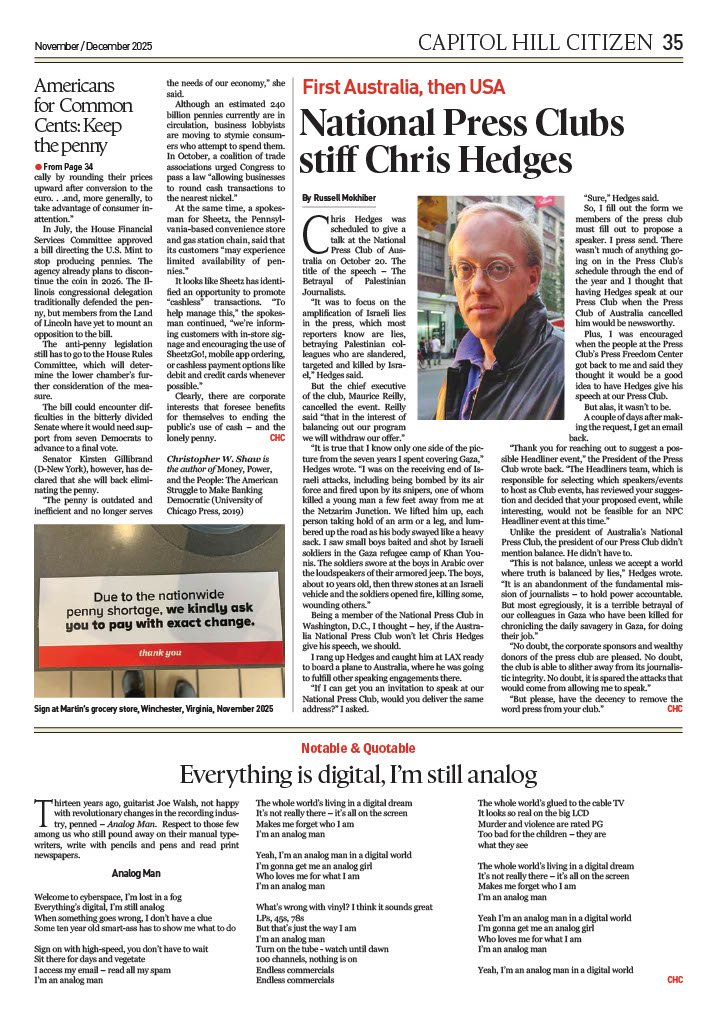
National Press Club of Australia Cancels Talk by Chris Hedges — Sparks Debate Over Press Freedom
Pulitzer-winning journalist’s scheduled address on Gaza journalists abruptly withdrawn, drawing backlash over alleged censorship and bias
The National Press Club of Australia (NPC) has cancelled a high-profile lecture by veteran journalist Chris Hedges, planned for 20 October 2025, only days before the scheduled date — prompting renewed debate over press freedom and institutional impartiality.
Hedges had been invited to deliver a talk titled “The Betrayal of Palestinian Journalists,” intended to highlight the risks faced by media workers in Gaza and criticise the role of Western coverage of the conflict.
The cancellation was announced on 4 October, when the NPC said it had “decided to pursue other speakers” and that Hedges’ address had only been “tentatively agreed.”
Supporters of Hedges — including the Australian Friends of Palestine Association (AFOPA) — pushed back.
They produced documentation showing a formal confirmation email dated 8 September 2025 from the Press Club’s chief executive committing to the 20 October event.
Screenshots of a now-deleted listing on the NPC’s website, complete with a ticket price, further suggest the talk was publicly scheduled.
Critics argue the abrupt cancellation reflects institutional pressure to suppress dissenting voices on the war in Gaza.
Some media-freedom advocates speculated the decision may have been influenced by lobbying from pro-Israel groups — a claim the NPC has denied.
The Press Club insisted speaker selection is “independent and based solely on journalistic credentials and relevance,” rejecting any suggestion of outside interference or bias.
For his part, Hedges delivered the address elsewhere, telling an audience the evening of 20 October that the shutdown exemplified broader suppression of critical journalism.
He argued the silencing of such voices undermines public access to perspectives challenging official narratives about the Middle East conflict.
The episode has sparked a broader discussion across Australia and beyond about the role of press-club institutions in fair discourse.
Observers warn that if major media venues decline to host critical viewpoints, independent media platforms and alternative venues may become the only outlets for dissent — a shift that could reshape how contentious global issues are debated in public.
Whether the NPC’s cancellation will prompt reconsideration of its policies — or entrench a pattern of selective exposure — remains to be seen.
This controversy also underscores the fragility of press freedom when institutional and political sensitivities intersect.
Many argue the right to speak and to listen to difficult truths is foundational to democracy — particularly on matters of war, human rights and journalistic integrity.
Hedges had been invited to deliver a talk titled “The Betrayal of Palestinian Journalists,” intended to highlight the risks faced by media workers in Gaza and criticise the role of Western coverage of the conflict.
The cancellation was announced on 4 October, when the NPC said it had “decided to pursue other speakers” and that Hedges’ address had only been “tentatively agreed.”
Supporters of Hedges — including the Australian Friends of Palestine Association (AFOPA) — pushed back.
They produced documentation showing a formal confirmation email dated 8 September 2025 from the Press Club’s chief executive committing to the 20 October event.
Screenshots of a now-deleted listing on the NPC’s website, complete with a ticket price, further suggest the talk was publicly scheduled.
Critics argue the abrupt cancellation reflects institutional pressure to suppress dissenting voices on the war in Gaza.
Some media-freedom advocates speculated the decision may have been influenced by lobbying from pro-Israel groups — a claim the NPC has denied.
The Press Club insisted speaker selection is “independent and based solely on journalistic credentials and relevance,” rejecting any suggestion of outside interference or bias.
For his part, Hedges delivered the address elsewhere, telling an audience the evening of 20 October that the shutdown exemplified broader suppression of critical journalism.
He argued the silencing of such voices undermines public access to perspectives challenging official narratives about the Middle East conflict.
The episode has sparked a broader discussion across Australia and beyond about the role of press-club institutions in fair discourse.
Observers warn that if major media venues decline to host critical viewpoints, independent media platforms and alternative venues may become the only outlets for dissent — a shift that could reshape how contentious global issues are debated in public.
Whether the NPC’s cancellation will prompt reconsideration of its policies — or entrench a pattern of selective exposure — remains to be seen.
This controversy also underscores the fragility of press freedom when institutional and political sensitivities intersect.
Many argue the right to speak and to listen to difficult truths is foundational to democracy — particularly on matters of war, human rights and journalistic integrity.