Focus on the BIG picture.
Friday, May 01, 2026
Outside the box.

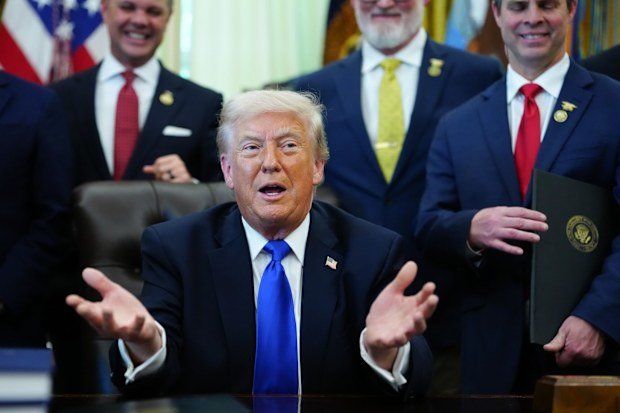
Trump Proposes New Retirement ‘Super System’ Modeled Against Australia’s Pension Framework
Plan aims to expand private savings and reshape US retirement structure, drawing comparisons with compulsory superannuation model
Political leadership from Donald Trump is driving a proposal to overhaul elements of the United States retirement system, with the former president outlining plans for a new savings structure he claims would outperform Australia’s compulsory superannuation model.
What is confirmed is that Trump has publicly referenced Australia’s retirement system—commonly known as superannuation—as a benchmark, while arguing that the United States could implement a more effective version tailored to its own economic structure.
His proposal centers on expanding private retirement savings mechanisms rather than relying solely on existing public programs such as Social Security.
Australia’s system is based on mandatory employer contributions into individual retirement accounts, with funds invested across financial markets.
Over decades, this structure has accumulated large pools of long-term capital and increased household retirement savings.
It is widely regarded as a system that shifts responsibility toward individuals while maintaining regulatory oversight and tax incentives.
Trump’s proposal appears to draw on these core elements but adapts them to a different policy context.
The mechanism under discussion involves encouraging or requiring higher levels of private contributions, potentially supported by tax advantages and regulatory changes designed to increase participation.
The stated objective is to boost long-term savings, reduce pressure on public pension systems, and expand domestic investment capital.
The key issue is structural compatibility.
The United States retirement framework is built around a combination of Social Security, employer-sponsored plans such as 401(k)s, and individual savings.
Introducing a system closer to Australia’s would require significant legislative change, coordination with employers, and decisions about whether participation would be voluntary or mandatory.
Supporters of the concept argue that increasing private savings could strengthen retirement security and deepen capital markets, providing more stable funding for infrastructure and business investment.
They point to Australia’s large pension fund sector as evidence that such systems can generate long-term economic benefits alongside retirement income.
Critics raise concerns about equity and transition risk.
Mandatory or heavily incentivized contributions could impose additional costs on employers and workers, particularly lower-income households.
There are also questions about how existing systems would integrate with a new framework, and whether individuals would face greater exposure to market volatility if retirement outcomes depend more heavily on investment performance.
The proposal also carries political implications.
Retirement policy in the United States is highly sensitive, and changes to Social Security or tax-advantaged savings accounts have historically faced significant resistance.
Framing the plan as an improvement on an established international model is a strategic attempt to ground the proposal in a proven system while differentiating it through scale or design.
The broader context is demographic and fiscal pressure.
Aging populations are increasing the cost of public pension systems across developed economies, prompting governments to explore ways to shift part of the burden toward private savings.
Australia’s model is often cited in these debates because of its long-term accumulation of retirement assets.
The immediate consequence of Trump’s proposal is to inject a comparative international framework into US retirement policy discussions, with Australia’s system serving as both reference point and benchmark.
The next phase will depend on whether the proposal translates into detailed policy design and legislative action, which would determine how such a system could be implemented within the existing US structure.
What is confirmed is that Trump has publicly referenced Australia’s retirement system—commonly known as superannuation—as a benchmark, while arguing that the United States could implement a more effective version tailored to its own economic structure.
His proposal centers on expanding private retirement savings mechanisms rather than relying solely on existing public programs such as Social Security.
Australia’s system is based on mandatory employer contributions into individual retirement accounts, with funds invested across financial markets.
Over decades, this structure has accumulated large pools of long-term capital and increased household retirement savings.
It is widely regarded as a system that shifts responsibility toward individuals while maintaining regulatory oversight and tax incentives.
Trump’s proposal appears to draw on these core elements but adapts them to a different policy context.
The mechanism under discussion involves encouraging or requiring higher levels of private contributions, potentially supported by tax advantages and regulatory changes designed to increase participation.
The stated objective is to boost long-term savings, reduce pressure on public pension systems, and expand domestic investment capital.
The key issue is structural compatibility.
The United States retirement framework is built around a combination of Social Security, employer-sponsored plans such as 401(k)s, and individual savings.
Introducing a system closer to Australia’s would require significant legislative change, coordination with employers, and decisions about whether participation would be voluntary or mandatory.
Supporters of the concept argue that increasing private savings could strengthen retirement security and deepen capital markets, providing more stable funding for infrastructure and business investment.
They point to Australia’s large pension fund sector as evidence that such systems can generate long-term economic benefits alongside retirement income.
Critics raise concerns about equity and transition risk.
Mandatory or heavily incentivized contributions could impose additional costs on employers and workers, particularly lower-income households.
There are also questions about how existing systems would integrate with a new framework, and whether individuals would face greater exposure to market volatility if retirement outcomes depend more heavily on investment performance.
The proposal also carries political implications.
Retirement policy in the United States is highly sensitive, and changes to Social Security or tax-advantaged savings accounts have historically faced significant resistance.
Framing the plan as an improvement on an established international model is a strategic attempt to ground the proposal in a proven system while differentiating it through scale or design.
The broader context is demographic and fiscal pressure.
Aging populations are increasing the cost of public pension systems across developed economies, prompting governments to explore ways to shift part of the burden toward private savings.
Australia’s model is often cited in these debates because of its long-term accumulation of retirement assets.
The immediate consequence of Trump’s proposal is to inject a comparative international framework into US retirement policy discussions, with Australia’s system serving as both reference point and benchmark.
The next phase will depend on whether the proposal translates into detailed policy design and legislative action, which would determine how such a system could be implemented within the existing US structure.