Focus on the BIG picture.
Wednesday, Jul 22, 2026
Outside the box.

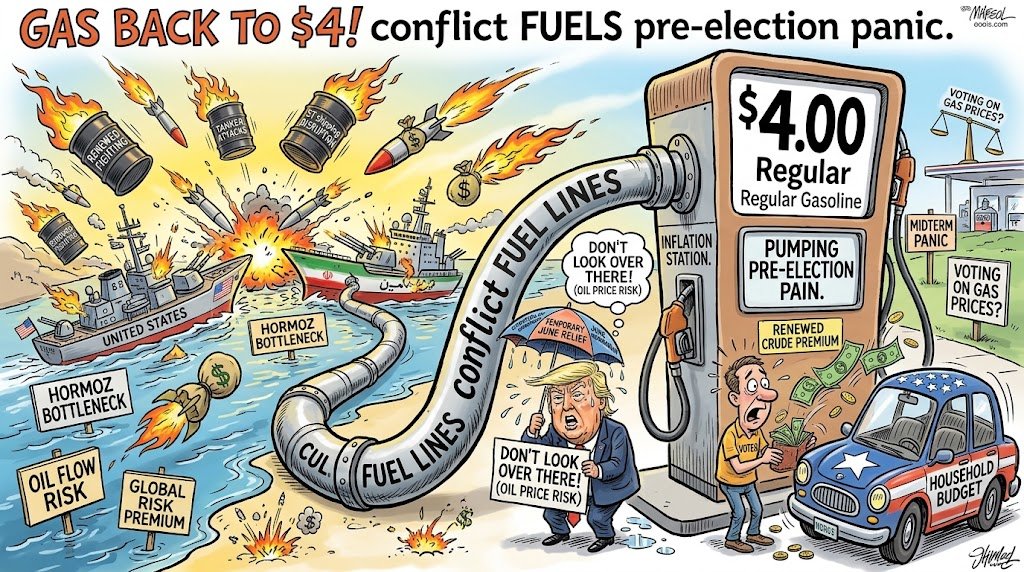
US Gasoline Returns to $4 as Renewed Iran Fighting Disrupts Oil Flows
Higher crude and refining costs are reversing June’s fuel-price relief, renewing inflation pressure and creating a political liability before the midterm elections.
Renewed fighting between the United States and Iran has pushed the national average price of regular gasoline back above four dollars a gallon, reversing much of the relief that followed a temporary reopening of the Strait of Hormuz.
The benchmark reached approximately $4.00 on July 20 for the first time since mid-June as attacks and shipping disruption restored a substantial risk premium to global oil prices.
The threshold is economically modest but politically potent.
Gasoline prices are displayed publicly, paid frequently and difficult for many households to avoid.
Their return to four dollars provides voters with an immediate measure of the domestic cost of a conflict that began in February and resumed in July after an interim agreement broke down.
Different price surveys use distinct station samples and methodologies, producing slightly different national figures.
One widely followed daily measure placed regular unleaded gasoline at $4.003 a gallon on Monday.
The federal weekly survey recorded regular gasoline at $4.001 and the average across all grades at $4.131.
Both confirmed the same movement: pump prices had crossed four dollars again.
Regular gasoline has risen by roughly 34 percent since the war began, although it remains about 12 percent below the May peak of more than $4.56 a gallon.
Prices had fallen to approximately $3.78 in early July after a June memorandum of understanding increased tanker traffic through Hormuz and encouraged expectations that suspended oil production would gradually return.
That improvement proved fragile.
Washington and Tehran subsequently accused each other of violating the arrangement, and military exchanges resumed on July 7. United States forces renewed strikes against Iranian missile, drone, air-defense and maritime facilities.
Iran answered with attacks on American positions and commercial shipping, again constricting traffic through the strait.
Hormuz is not simply a regional waterway.
In normal conditions, approximately 20 million barrels of oil and petroleum products pass through it each day, equivalent to about one-fifth of global petroleum consumption.
Saudi Arabia, Iraq, Kuwait, the United Arab Emirates, Qatar, Bahrain and Iran rely on the route for much of their energy trade, while alternative pipelines can replace only part of its capacity.
The disruption affects prices even when physical shortages have not reached American filling stations.
Traders raise the value of crude to reflect the probability of future supply losses, tanker operators demand additional compensation for danger, insurers increase premiums and shipping routes become less efficient.
Refiners then pay more for crude or imported fuel components, and those costs filter through wholesale markets to retailers.
International benchmark crude traded in a range around the high eighties to low nineties in dollars per barrel as the conflict intensified.
That was below the levels above one hundred dollars reached during earlier phases of the war, but high enough to lift wholesale gasoline rapidly.
Crude oil normally accounts for the largest component of the retail price, followed by refining, distribution, marketing and taxes.
Summer conditions add pressure.
American motorists travel more, while refiners must produce costlier fuel formulations intended to reduce air pollution.
Refinery interruptions, limited inventories or regional transport constraints can therefore magnify a global crude-price increase during the peak driving season.
The national average conceals sharp geographic differences.
California, Hawaii and Washington have prices substantially above four dollars because of taxes, environmental specifications, constrained refinery networks and transport costs.
Several lower-cost states remain well below the threshold.
The effect on an individual household depends on location, vehicle efficiency and the distance required for work or essential services.
Diesel presents a broader inflation risk.
Its national average exceeded $5.10 a gallon, raising operating expenses for trucking, agriculture, construction and other industries.
Because almost every physical product travels by truck during some stage of distribution, sustained diesel increases can migrate into grocery, retail and manufacturing prices even for consumers who do not purchase the fuel directly.
The latest increase came immediately after inflation data appeared to show some improvement.
Consumer prices fell 0.4 percent in June from the previous month as energy costs declined.
Annual inflation nevertheless remained 3.5 percent, while energy prices were 15.7 percent higher than a year earlier and gasoline was up 26.7 percent.
The June report largely predates the renewed hostilities, making it a backward-looking picture of the temporary fuel-price retreat.
If gasoline remains elevated, the direct effect will appear in subsequent inflation figures.
Secondary consequences could emerge through freight charges, air travel and the cost of producing goods.
A brief spike would have a limited lasting impact; a prolonged interruption to Hormuz would create a more persistent shock and complicate decisions about interest rates.
President Donald Trump’s administration argues that military pressure is necessary to protect American forces, prevent Iranian threats and restore secure commercial passage through the strait.
The White House can also point to the June agreement as evidence that force and negotiation previously reopened the route.
Opponents contend that renewed hostilities have imposed avoidable costs on motorists and widened a conflict whose strategic outcome remains contested.
The political exposure is immediate because the November midterm elections will determine control of Congress.
Presidents do not set retail gasoline prices, which respond to global crude markets, refinery economics, taxes and local competition.
Voters nevertheless tend to assign responsibility to the administration in power, especially when fuel costs rise alongside a war directed from Washington.
Recent polling has shown weak public assessments of the economy and substantial dissatisfaction with the conflict.
Those findings do not establish that gasoline alone determines political support, but the price increase reinforces an existing concern about affordability.
It also gives opposition candidates a visible figure around which to organize criticism.
The future trajectory now depends primarily on security and shipping through Hormuz.
Restored tanker traffic and revived Gulf production would reduce the risk premium and eventually reach American pumps, although retail prices often adjust with a delay.
Continued attacks would preserve pressure on crude, refining and freight costs.
With regular gasoline again at four dollars and diesel above five dollars, the renewed war has already moved from the battlefield into household and business budgets.
The benchmark reached approximately $4.00 on July 20 for the first time since mid-June as attacks and shipping disruption restored a substantial risk premium to global oil prices.
The threshold is economically modest but politically potent.
Gasoline prices are displayed publicly, paid frequently and difficult for many households to avoid.
Their return to four dollars provides voters with an immediate measure of the domestic cost of a conflict that began in February and resumed in July after an interim agreement broke down.
Different price surveys use distinct station samples and methodologies, producing slightly different national figures.
One widely followed daily measure placed regular unleaded gasoline at $4.003 a gallon on Monday.
The federal weekly survey recorded regular gasoline at $4.001 and the average across all grades at $4.131.
Both confirmed the same movement: pump prices had crossed four dollars again.
Regular gasoline has risen by roughly 34 percent since the war began, although it remains about 12 percent below the May peak of more than $4.56 a gallon.
Prices had fallen to approximately $3.78 in early July after a June memorandum of understanding increased tanker traffic through Hormuz and encouraged expectations that suspended oil production would gradually return.
That improvement proved fragile.
Washington and Tehran subsequently accused each other of violating the arrangement, and military exchanges resumed on July 7. United States forces renewed strikes against Iranian missile, drone, air-defense and maritime facilities.
Iran answered with attacks on American positions and commercial shipping, again constricting traffic through the strait.
Hormuz is not simply a regional waterway.
In normal conditions, approximately 20 million barrels of oil and petroleum products pass through it each day, equivalent to about one-fifth of global petroleum consumption.
Saudi Arabia, Iraq, Kuwait, the United Arab Emirates, Qatar, Bahrain and Iran rely on the route for much of their energy trade, while alternative pipelines can replace only part of its capacity.
The disruption affects prices even when physical shortages have not reached American filling stations.
Traders raise the value of crude to reflect the probability of future supply losses, tanker operators demand additional compensation for danger, insurers increase premiums and shipping routes become less efficient.
Refiners then pay more for crude or imported fuel components, and those costs filter through wholesale markets to retailers.
International benchmark crude traded in a range around the high eighties to low nineties in dollars per barrel as the conflict intensified.
That was below the levels above one hundred dollars reached during earlier phases of the war, but high enough to lift wholesale gasoline rapidly.
Crude oil normally accounts for the largest component of the retail price, followed by refining, distribution, marketing and taxes.
Summer conditions add pressure.
American motorists travel more, while refiners must produce costlier fuel formulations intended to reduce air pollution.
Refinery interruptions, limited inventories or regional transport constraints can therefore magnify a global crude-price increase during the peak driving season.
The national average conceals sharp geographic differences.
California, Hawaii and Washington have prices substantially above four dollars because of taxes, environmental specifications, constrained refinery networks and transport costs.
Several lower-cost states remain well below the threshold.
The effect on an individual household depends on location, vehicle efficiency and the distance required for work or essential services.
Diesel presents a broader inflation risk.
Its national average exceeded $5.10 a gallon, raising operating expenses for trucking, agriculture, construction and other industries.
Because almost every physical product travels by truck during some stage of distribution, sustained diesel increases can migrate into grocery, retail and manufacturing prices even for consumers who do not purchase the fuel directly.
The latest increase came immediately after inflation data appeared to show some improvement.
Consumer prices fell 0.4 percent in June from the previous month as energy costs declined.
Annual inflation nevertheless remained 3.5 percent, while energy prices were 15.7 percent higher than a year earlier and gasoline was up 26.7 percent.
The June report largely predates the renewed hostilities, making it a backward-looking picture of the temporary fuel-price retreat.
If gasoline remains elevated, the direct effect will appear in subsequent inflation figures.
Secondary consequences could emerge through freight charges, air travel and the cost of producing goods.
A brief spike would have a limited lasting impact; a prolonged interruption to Hormuz would create a more persistent shock and complicate decisions about interest rates.
President Donald Trump’s administration argues that military pressure is necessary to protect American forces, prevent Iranian threats and restore secure commercial passage through the strait.
The White House can also point to the June agreement as evidence that force and negotiation previously reopened the route.
Opponents contend that renewed hostilities have imposed avoidable costs on motorists and widened a conflict whose strategic outcome remains contested.
The political exposure is immediate because the November midterm elections will determine control of Congress.
Presidents do not set retail gasoline prices, which respond to global crude markets, refinery economics, taxes and local competition.
Voters nevertheless tend to assign responsibility to the administration in power, especially when fuel costs rise alongside a war directed from Washington.
Recent polling has shown weak public assessments of the economy and substantial dissatisfaction with the conflict.
Those findings do not establish that gasoline alone determines political support, but the price increase reinforces an existing concern about affordability.
It also gives opposition candidates a visible figure around which to organize criticism.
The future trajectory now depends primarily on security and shipping through Hormuz.
Restored tanker traffic and revived Gulf production would reduce the risk premium and eventually reach American pumps, although retail prices often adjust with a delay.
Continued attacks would preserve pressure on crude, refining and freight costs.
With regular gasoline again at four dollars and diesel above five dollars, the renewed war has already moved from the battlefield into household and business budgets.