Focus on the BIG picture.
Thursday, Jan 29, 2026
Outside the box.

NTSB Finds Deep Systemic Failures Behind Deadly Midair Collision Over Potomac River
Investigation concludes that layered regulatory, procedural and communication breakdowns created conditions for the 2025 collision near Washington, killing 67 people
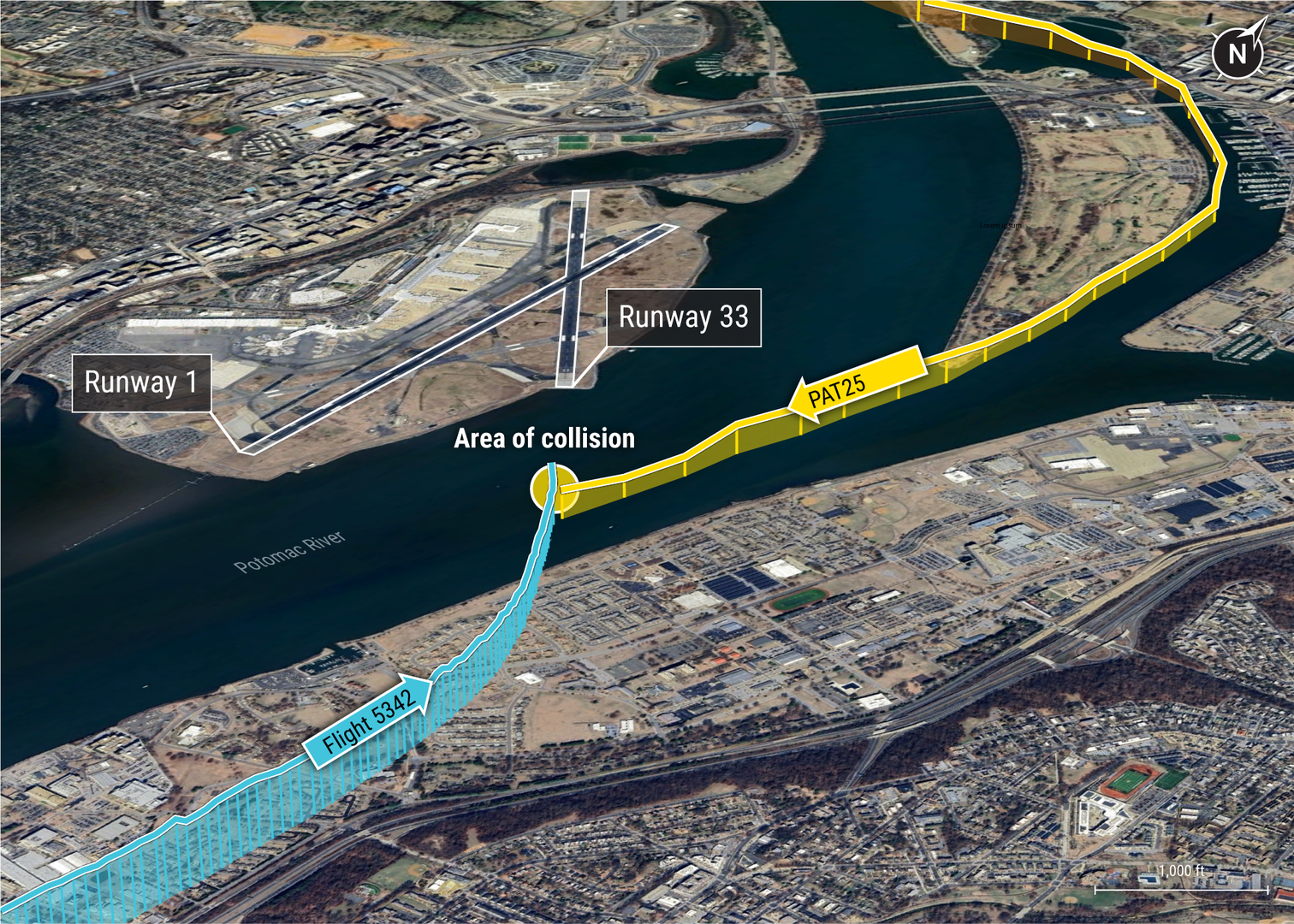
The National Transportation Safety Board has concluded that a series of underlying systemic failures, rather than a single cause, led to the devastating midair collision over the Potomac River near Ronald Reagan Washington National Airport that killed all 67 people aboard both aircraft in January 2025. At a public hearing in Washington, D.C., NTSB Chair Jennifer Homendy said multiple flaws — in airspace design, equipment, air traffic control procedures and regulatory oversight — converged to create an unsafe environment for aircraft operations in one of the nation’s busiest airspaces.
Investigators identified several key contributing factors.
The helicopter was flying along a congested route close to the airport’s approach paths, a configuration long criticised by controllers and industry experts as inherently dangerous.
Equipment malfunctions on the Army helicopter, including an inaccurate altimeter and a nonfunctional broadcast transponder, further degraded situational awareness.
Air traffic controllers, overwhelmed by high traffic volumes and a complex airspace, did not effectively separate the Black Hawk from the American Airlines regional jet on final approach, while communications between controllers and pilots were incomplete.
The NTSB also sharply criticised the Federal Aviation Administration for years of inaction on safety concerns raised by controllers and other aviation personnel.
Tower staff had repeatedly warned that helicopter routes intersected too closely with commercial traffic paths and that separation standards were inadequate, yet the FAA did not implement effective changes before the collision.
The board’s findings echoed testimony that similar risks had been flagged as far back as the early 2010s, but warnings went largely unheeded.
As part of its formal recommendations, the NTSB approved nearly fifty safety proposals aimed at preventing future tragedies, including requiring aircraft to be equipped with transponders capable of both sending and receiving location data, improving air traffic controller training and staffing, reconfiguring helicopter corridors around busy airports, and enhancing coordination between military and civilian aviation authorities.
Officials also urged broader regulatory reform to address persistent gaps in the national airspace system’s safety architecture.
In recounting the collision’s circumstances, investigators emphasised that no individual error alone caused the catastrophe; rather, it was the alignment of multiple institutional vulnerabilities and communication breakdowns that permitted the fatal encounter.
The tragedy remains the deadliest U.S. aviation disaster in decades, prompting calls for comprehensive changes to how the nation manages increasingly crowded skies around major airports.
Investigators identified several key contributing factors.
The helicopter was flying along a congested route close to the airport’s approach paths, a configuration long criticised by controllers and industry experts as inherently dangerous.
Equipment malfunctions on the Army helicopter, including an inaccurate altimeter and a nonfunctional broadcast transponder, further degraded situational awareness.
Air traffic controllers, overwhelmed by high traffic volumes and a complex airspace, did not effectively separate the Black Hawk from the American Airlines regional jet on final approach, while communications between controllers and pilots were incomplete.
The NTSB also sharply criticised the Federal Aviation Administration for years of inaction on safety concerns raised by controllers and other aviation personnel.
Tower staff had repeatedly warned that helicopter routes intersected too closely with commercial traffic paths and that separation standards were inadequate, yet the FAA did not implement effective changes before the collision.
The board’s findings echoed testimony that similar risks had been flagged as far back as the early 2010s, but warnings went largely unheeded.
As part of its formal recommendations, the NTSB approved nearly fifty safety proposals aimed at preventing future tragedies, including requiring aircraft to be equipped with transponders capable of both sending and receiving location data, improving air traffic controller training and staffing, reconfiguring helicopter corridors around busy airports, and enhancing coordination between military and civilian aviation authorities.
Officials also urged broader regulatory reform to address persistent gaps in the national airspace system’s safety architecture.
In recounting the collision’s circumstances, investigators emphasised that no individual error alone caused the catastrophe; rather, it was the alignment of multiple institutional vulnerabilities and communication breakdowns that permitted the fatal encounter.
The tragedy remains the deadliest U.S. aviation disaster in decades, prompting calls for comprehensive changes to how the nation manages increasingly crowded skies around major airports.