Focus on the BIG picture.
Friday, Jan 02, 2026
Outside the box.

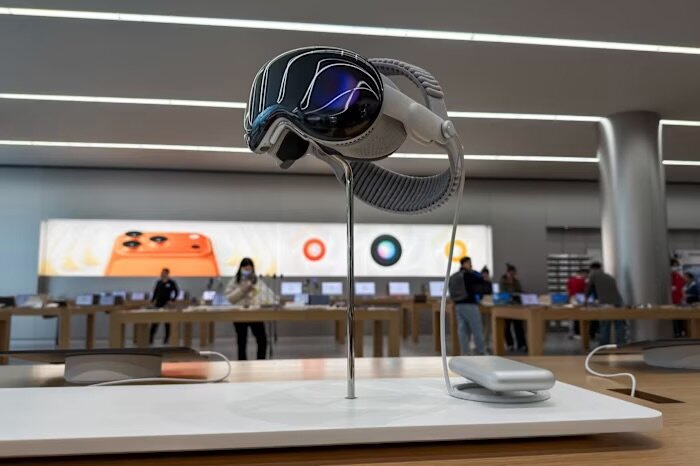
Apple Cuts Vision Pro Production and Marketing After Weak Sales Performance
Apple has significantly scaled back production and promotional efforts for its high-end Vision Pro headset following lower-than-expected demand and sluggish sales, industry data shows.
Apple Inc. has substantially reduced production and marketing for its Vision Pro mixed-reality headset after consumer demand failed to match early expectations, according to market intelligence and industry analysts.
The device, priced starting at three thousand four hundred ninety-nine U.S. dollars, was envisioned as a strategic expansion beyond Apple’s core smartphone and personal computing products.
However, the first-generation headset has struggled to achieve broad market adoption since its launch.
Data from the international research firm IDC indicates that Apple shipped approximately three hundred ninety thousand Vision Pro units during 2024 around its debut, but production at contract manufacturer Luxshare effectively halted at the beginning of 2025 amid waning demand.
In the crucial holiday quarter at the end of 2025, IDC estimates Apple shipped only about forty-five thousand new headsets.
This figure is sharply lower than typical sales volumes for Apple’s other hardware categories.
Complementing the production cutbacks, digital advertising and promotional activity tied to Vision Pro has plunged by more than ninety-five percent year-on-year in major markets, including the United States and the United Kingdom, according to analytics firm Sensor Tower.
Apple has not publicly disclosed official sales figures or addressed these strategic shifts.
Analysts point to several factors behind the device’s subdued market performance.
The premium price point places the Vision Pro well above most existing virtual and mixed-reality headsets.
Critics also cite the headset’s relatively bulky form factor, limited battery life for extended use, and a modest ecosystem of native apps for its VisionOS platform as inhibiting broader consumer appeal.
According to industry observers, only about three thousand VisionOS-specific applications are available, far fewer than the tens of thousands of apps typically seen on other Apple platforms early in their lifecycles.
The broader mixed-reality headset market itself has contracted, with some research showing overall hardware sales declining and competitors such as Meta’s Quest family dominating a large share of the lower-priced segment.
In response to the Vision Pro’s performance, Apple is believed to be pivoting toward development of a more affordable mixed-reality device aimed at expanding its addressable market.
A recently released upgraded Vision Pro with an enhanced chip and improved comfort features suggests Apple is refining its strategy, even as current production and marketing are scaled back.
The Vision Pro’s trajectory underscores the challenges facing premium mixed-reality hardware in converting early technological enthusiasm into mass consumer adoption.
Apple’s recalibration of production and promotional investment reflects a broader reassessment of how spatial computing fits within the company’s product ecosystem and the wider industry landscape.
The device, priced starting at three thousand four hundred ninety-nine U.S. dollars, was envisioned as a strategic expansion beyond Apple’s core smartphone and personal computing products.
However, the first-generation headset has struggled to achieve broad market adoption since its launch.
Data from the international research firm IDC indicates that Apple shipped approximately three hundred ninety thousand Vision Pro units during 2024 around its debut, but production at contract manufacturer Luxshare effectively halted at the beginning of 2025 amid waning demand.
In the crucial holiday quarter at the end of 2025, IDC estimates Apple shipped only about forty-five thousand new headsets.
This figure is sharply lower than typical sales volumes for Apple’s other hardware categories.
Complementing the production cutbacks, digital advertising and promotional activity tied to Vision Pro has plunged by more than ninety-five percent year-on-year in major markets, including the United States and the United Kingdom, according to analytics firm Sensor Tower.
Apple has not publicly disclosed official sales figures or addressed these strategic shifts.
Analysts point to several factors behind the device’s subdued market performance.
The premium price point places the Vision Pro well above most existing virtual and mixed-reality headsets.
Critics also cite the headset’s relatively bulky form factor, limited battery life for extended use, and a modest ecosystem of native apps for its VisionOS platform as inhibiting broader consumer appeal.
According to industry observers, only about three thousand VisionOS-specific applications are available, far fewer than the tens of thousands of apps typically seen on other Apple platforms early in their lifecycles.
The broader mixed-reality headset market itself has contracted, with some research showing overall hardware sales declining and competitors such as Meta’s Quest family dominating a large share of the lower-priced segment.
In response to the Vision Pro’s performance, Apple is believed to be pivoting toward development of a more affordable mixed-reality device aimed at expanding its addressable market.
A recently released upgraded Vision Pro with an enhanced chip and improved comfort features suggests Apple is refining its strategy, even as current production and marketing are scaled back.
The Vision Pro’s trajectory underscores the challenges facing premium mixed-reality hardware in converting early technological enthusiasm into mass consumer adoption.
Apple’s recalibration of production and promotional investment reflects a broader reassessment of how spatial computing fits within the company’s product ecosystem and the wider industry landscape.