Focus on the BIG picture.
Friday, Mar 20, 2026
Outside the box.

0:00
0:00
Trump Administration’s Iran Military Buildup and Sanctions Campaign Puts Deterrence Credibility on the Line
As Iran moves to restore internet access after a prolonged blackout, Washington signals it is positioning forces and tightening oil-related sanctions to be ready for rapid retaliation if Tehran escalates.
The core issue is deterrence credibility: whether the Trump administration’s visible military buildup and sanctions pressure can restrain Iran’s next move without triggering a wider regional clash.
This matters now because the U.S. is publicly tying readiness to the risk of Iranian escalation, Iran is issuing warnings that U.S. bases would be targeted, and regional spillovers are already showing up in aviation disruptions and heightened security posture.
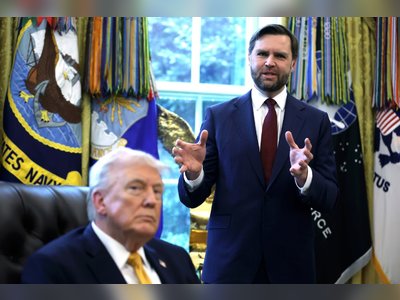
What we can confirm is that Vice President J.D. Vance said the U.S. is accumulating forces in the Middle East to ensure resources are available if Iran does “something very foolish,” and he emphasized that President Donald Trump has options he will not disclose.
What we can confirm is that Iran indicated internet service would be restored nationwide within a short window after an extended blackout, and that Iranian commanders issued a message framed as an answer to President Trump “on the ground.” What’s still unclear is the precise trigger threshold that would cause the U.S. to shift from deterrence to direct action, and the accuracy of competing claims about executions and casualty totals: President Trump described preventing a large number of executions, while Iran’s prosecutor rejected a specific execution claim, and multiple actors cite sharply different death toll figures with no single, universally verified baseline.
Mechanism: Deterrence works when one side convinces the other that certain actions will bring swift, painful consequences that outweigh any expected benefit.
The U.S. builds deterrence by moving ships, air defenses, and personnel into position, by signaling political will through public statements, and by squeezing resources through sanctions.
Iran counters by signaling that escalation would impose costs on U.S. forces and partners in the region, and by shaping domestic control through information restriction and internal security measures.
Unit economics: The U.S. cost curve rises with deployed assets, readiness tempo, air defense coverage, and sustained maritime presence; those costs scale with time and operational intensity, not with public messaging.
Iran’s revenue vulnerability rises with enforcement against oil transport networks and intermediary entities; pressure scales with how effectively sanctions restrict flows and financing.
Both sides face a margins problem: the U.S. wants maximum deterrence per deployed dollar and minimal escalation risk, while Iran wants maximum strategic effect per constrained resource, using asymmetric threats that are cheaper than matching U.S. conventional power.
Stakeholder leverage: Washington holds leverage through force projection, sanctions reach, and the ability to reassure or coordinate with regional partners who host bases and rely on U.S. security guarantees.
Iran holds leverage through its ability to create regional risk that raises insurance, aviation disruption, and force protection burdens, and through the threat set it can direct at nearby U.S. facilities.
Regional states and host nations hold practical leverage because basing access, overflight permissions, and political tolerance for prolonged crisis conditions can widen or narrow U.S. operational options.
Competitive dynamics: Competitive pressure forces both capitals into tight trade-offs.
The U.S. must show credibility without being pulled into open-ended conflict, because adversaries and partners both read hesitation as weakness and overreach as recklessness.
Iran must balance domestic control, regime stability, and external signaling; overreaction invites heavier pressure, while underreaction risks appearing deterred and emboldening rivals.
Each side is attempting to shape the other’s decision calculus faster than events on the ground can outrun command and control.
Scenarios: Base case: the U.S. maintains elevated posture and selective economic pressure while Iran avoids actions that cross Washington’s stated red lines; early indicators include continued force positioning paired with restrained public thresholds and gradual restoration of communications inside Iran.
Bull case: deterrence holds and the crisis cools into a contained standoff; triggers include sustained Iranian avoidance of high-visibility escalations and measurable reduction in execution-related fears, with fewer transportation and aviation disruptions.
Bear case: a sharp incident forces rapid retaliation and turns signaling into kinetic exchange; triggers include credible evidence of mass executions, attacks or attempted attacks on U.S. forces or facilities, or a sequence of tit-for-tat moves that compress decision time and raise miscalculation risk.
What to watch:
- Whether U.S. officials restate or narrow the conditions that would trigger direct action tied to executions.
- Whether Iran completes nationwide internet restoration on the timeline described.
- Any public confirmation that Iranian commanders’ “on the ground” message is followed by operational steps.
- Additional U.S. sanctions designations tied to oil transport networks and enabling companies.
- Observable changes in commercial aviation patterns involving Israel, Riyadh, Dubai, and nearby routes.
- Further announcements about U.S. air defense deployments or posture changes in the region.
- Any shift in Iranian rhetoric from deterrent warnings to specific operational threats against bases.
- Whether regional host nations request, limit, or expand defensive deployments.
- Signs of de-escalatory backchannels reflected in softened public language from either side.
- A sustained divergence between official Iranian casualty claims and activist or external estimates without new verifiable baselines.
Deterrence is a discipline, not a slogan: it works when threats are credible, limited, and backed by capability, and it fails when red lines are fuzzy or incentives push both sides toward tests of resolve.
The Trump administration’s approach is signaling readiness while preserving choice; Iran’s approach is signaling pain while preserving ambiguity.
The next moves will reveal which side is better at controlling escalation under pressure.
This matters now because the U.S. is publicly tying readiness to the risk of Iranian escalation, Iran is issuing warnings that U.S. bases would be targeted, and regional spillovers are already showing up in aviation disruptions and heightened security posture.
What we can confirm is that Vice President J.D. Vance said the U.S. is accumulating forces in the Middle East to ensure resources are available if Iran does “something very foolish,” and he emphasized that President Donald Trump has options he will not disclose.
What we can confirm is that Iran indicated internet service would be restored nationwide within a short window after an extended blackout, and that Iranian commanders issued a message framed as an answer to President Trump “on the ground.” What’s still unclear is the precise trigger threshold that would cause the U.S. to shift from deterrence to direct action, and the accuracy of competing claims about executions and casualty totals: President Trump described preventing a large number of executions, while Iran’s prosecutor rejected a specific execution claim, and multiple actors cite sharply different death toll figures with no single, universally verified baseline.
Mechanism: Deterrence works when one side convinces the other that certain actions will bring swift, painful consequences that outweigh any expected benefit.
The U.S. builds deterrence by moving ships, air defenses, and personnel into position, by signaling political will through public statements, and by squeezing resources through sanctions.
Iran counters by signaling that escalation would impose costs on U.S. forces and partners in the region, and by shaping domestic control through information restriction and internal security measures.
Unit economics: The U.S. cost curve rises with deployed assets, readiness tempo, air defense coverage, and sustained maritime presence; those costs scale with time and operational intensity, not with public messaging.
Iran’s revenue vulnerability rises with enforcement against oil transport networks and intermediary entities; pressure scales with how effectively sanctions restrict flows and financing.
Both sides face a margins problem: the U.S. wants maximum deterrence per deployed dollar and minimal escalation risk, while Iran wants maximum strategic effect per constrained resource, using asymmetric threats that are cheaper than matching U.S. conventional power.
Stakeholder leverage: Washington holds leverage through force projection, sanctions reach, and the ability to reassure or coordinate with regional partners who host bases and rely on U.S. security guarantees.
Iran holds leverage through its ability to create regional risk that raises insurance, aviation disruption, and force protection burdens, and through the threat set it can direct at nearby U.S. facilities.
Regional states and host nations hold practical leverage because basing access, overflight permissions, and political tolerance for prolonged crisis conditions can widen or narrow U.S. operational options.
Competitive dynamics: Competitive pressure forces both capitals into tight trade-offs.
The U.S. must show credibility without being pulled into open-ended conflict, because adversaries and partners both read hesitation as weakness and overreach as recklessness.
Iran must balance domestic control, regime stability, and external signaling; overreaction invites heavier pressure, while underreaction risks appearing deterred and emboldening rivals.
Each side is attempting to shape the other’s decision calculus faster than events on the ground can outrun command and control.
Scenarios: Base case: the U.S. maintains elevated posture and selective economic pressure while Iran avoids actions that cross Washington’s stated red lines; early indicators include continued force positioning paired with restrained public thresholds and gradual restoration of communications inside Iran.
Bull case: deterrence holds and the crisis cools into a contained standoff; triggers include sustained Iranian avoidance of high-visibility escalations and measurable reduction in execution-related fears, with fewer transportation and aviation disruptions.
Bear case: a sharp incident forces rapid retaliation and turns signaling into kinetic exchange; triggers include credible evidence of mass executions, attacks or attempted attacks on U.S. forces or facilities, or a sequence of tit-for-tat moves that compress decision time and raise miscalculation risk.
What to watch:
- Whether U.S. officials restate or narrow the conditions that would trigger direct action tied to executions.
- Whether Iran completes nationwide internet restoration on the timeline described.
- Any public confirmation that Iranian commanders’ “on the ground” message is followed by operational steps.
- Additional U.S. sanctions designations tied to oil transport networks and enabling companies.
- Observable changes in commercial aviation patterns involving Israel, Riyadh, Dubai, and nearby routes.
- Further announcements about U.S. air defense deployments or posture changes in the region.
- Any shift in Iranian rhetoric from deterrent warnings to specific operational threats against bases.
- Whether regional host nations request, limit, or expand defensive deployments.
- Signs of de-escalatory backchannels reflected in softened public language from either side.
- A sustained divergence between official Iranian casualty claims and activist or external estimates without new verifiable baselines.
Deterrence is a discipline, not a slogan: it works when threats are credible, limited, and backed by capability, and it fails when red lines are fuzzy or incentives push both sides toward tests of resolve.
The Trump administration’s approach is signaling readiness while preserving choice; Iran’s approach is signaling pain while preserving ambiguity.
The next moves will reveal which side is better at controlling escalation under pressure.