Focus on the BIG picture.
Saturday, Dec 20, 2025
Outside the box.

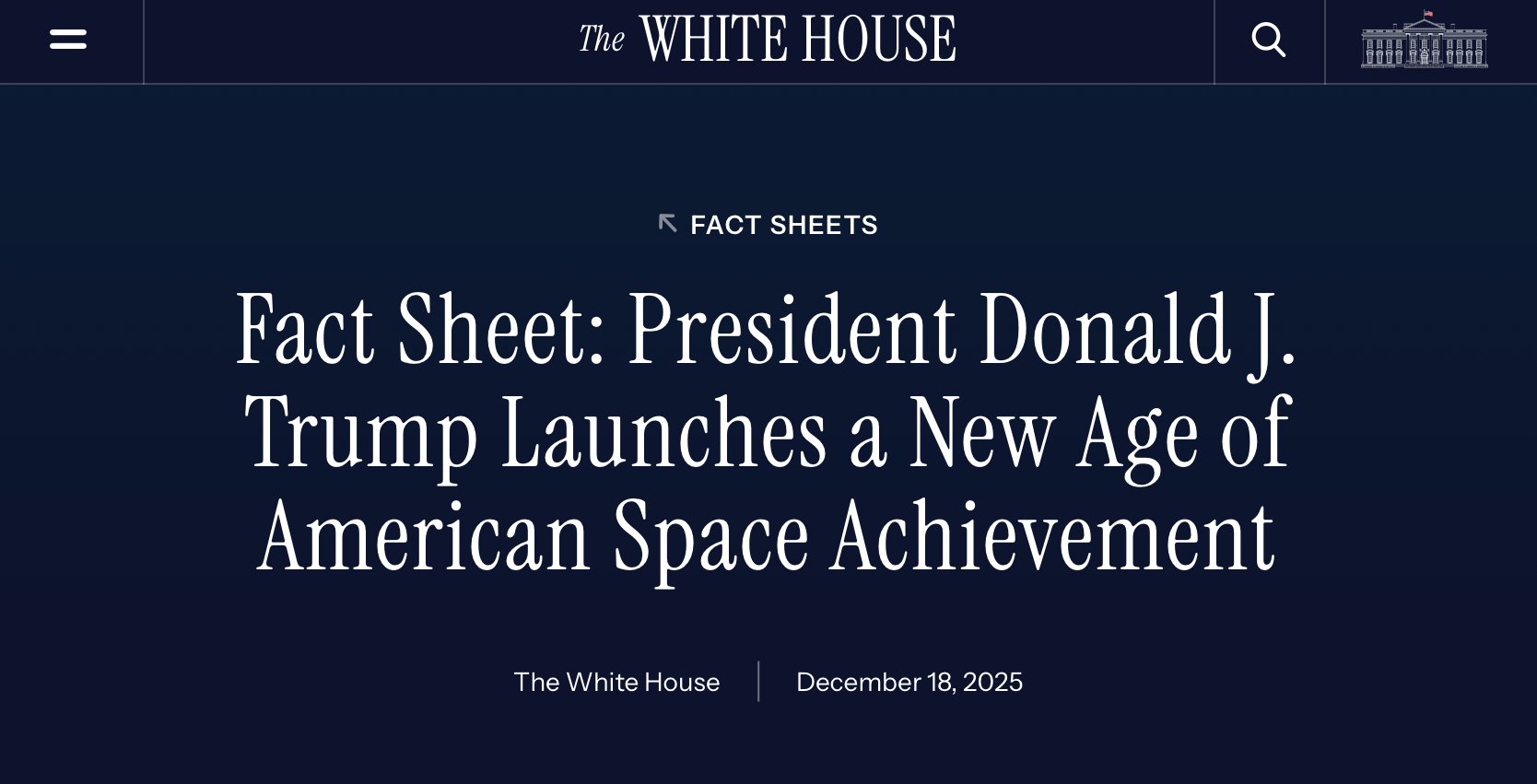
Trump Orders New American Space Push: Moon Return by 2028, Lunar Outpost by 2030, Mars Preparations Accelerated
A new executive order sets deadlines for a crewed Moon return, early construction of a permanent lunar foothold, and nuclear power deployment, while directing a commercial successor to the International Space Station by 2030.
President Donald J. Trump has signed a wide-ranging executive order setting out an “America First” space strategy aimed at restoring and securing clear U.S. leadership in exploration, national security, and space commerce.
The order directs the federal government to return American astronauts to the Moon by two thousand twenty-eight, begin establishing initial components of a permanent U.S. lunar outpost by two thousand thirty, and accelerate preparations for a future mission to Mars.
The executive order calls for nuclear power capabilities to support sustained operations beyond Earth, including plans for reactors in orbit and on the lunar surface.
It directs that a lunar surface reactor be prepared for launch by two thousand thirty, a timeline intended to provide reliable energy for long-duration missions, scientific work, and future infrastructure.
On national security, the order emphasizes the need to detect, characterize, and defeat a full range of threats to U.S. space interests.
It directs federal departments and agencies to align strategies and execution, reflecting an approach that treats space assets as essential to economic strength and military readiness.
The order also pushes a major commercial transition in low Earth orbit.
It directs the development of a commercial orbital destination intended to replace the International Space Station by two thousand thirty, alongside upgrades to launch infrastructure and efforts to accelerate private-sector innovation and investment.
The stated objective is to build a robust space economy driven by American entrepreneurship, with downstream benefits including high-wage jobs and improved satellite-enabled services such as positioning, navigation, timing, weather forecasting, and ubiquitous broadband connectivity.
To coordinate implementation, the order assigns the Assistant to the President for Science and Technology a central role in managing national space policy efforts.
It instructs government agencies to work together on execution, including simplifying procurement processes, aligning space-security strategies, and ensuring the workforce capacity required to meet the deadlines.
The administration portrays the order as a strategic response to intensifying global competition in space.
It links expanded American presence beyond Earth to national resilience and to a long tradition of U.S. frontier achievement, arguing that ambitious missions also drive practical innovation with broad civilian and industrial applications.
The order builds on earlier Trump-era actions cited by the administration, including the creation of the U.S. Space Force and a series of space policy directives issued during his first term.
It also follows a separate executive order signed in August two thousand twenty-five aimed at enabling competition in the commercial space industry, and earlier initiatives supporting small modular nuclear reactors for national security and space exploration, as well as policies encouraging the extraction and use of space resources.
The order directs the federal government to return American astronauts to the Moon by two thousand twenty-eight, begin establishing initial components of a permanent U.S. lunar outpost by two thousand thirty, and accelerate preparations for a future mission to Mars.
The executive order calls for nuclear power capabilities to support sustained operations beyond Earth, including plans for reactors in orbit and on the lunar surface.
It directs that a lunar surface reactor be prepared for launch by two thousand thirty, a timeline intended to provide reliable energy for long-duration missions, scientific work, and future infrastructure.
On national security, the order emphasizes the need to detect, characterize, and defeat a full range of threats to U.S. space interests.
It directs federal departments and agencies to align strategies and execution, reflecting an approach that treats space assets as essential to economic strength and military readiness.
The order also pushes a major commercial transition in low Earth orbit.
It directs the development of a commercial orbital destination intended to replace the International Space Station by two thousand thirty, alongside upgrades to launch infrastructure and efforts to accelerate private-sector innovation and investment.
The stated objective is to build a robust space economy driven by American entrepreneurship, with downstream benefits including high-wage jobs and improved satellite-enabled services such as positioning, navigation, timing, weather forecasting, and ubiquitous broadband connectivity.
To coordinate implementation, the order assigns the Assistant to the President for Science and Technology a central role in managing national space policy efforts.
It instructs government agencies to work together on execution, including simplifying procurement processes, aligning space-security strategies, and ensuring the workforce capacity required to meet the deadlines.
The administration portrays the order as a strategic response to intensifying global competition in space.
It links expanded American presence beyond Earth to national resilience and to a long tradition of U.S. frontier achievement, arguing that ambitious missions also drive practical innovation with broad civilian and industrial applications.
The order builds on earlier Trump-era actions cited by the administration, including the creation of the U.S. Space Force and a series of space policy directives issued during his first term.
It also follows a separate executive order signed in August two thousand twenty-five aimed at enabling competition in the commercial space industry, and earlier initiatives supporting small modular nuclear reactors for national security and space exploration, as well as policies encouraging the extraction and use of space resources.